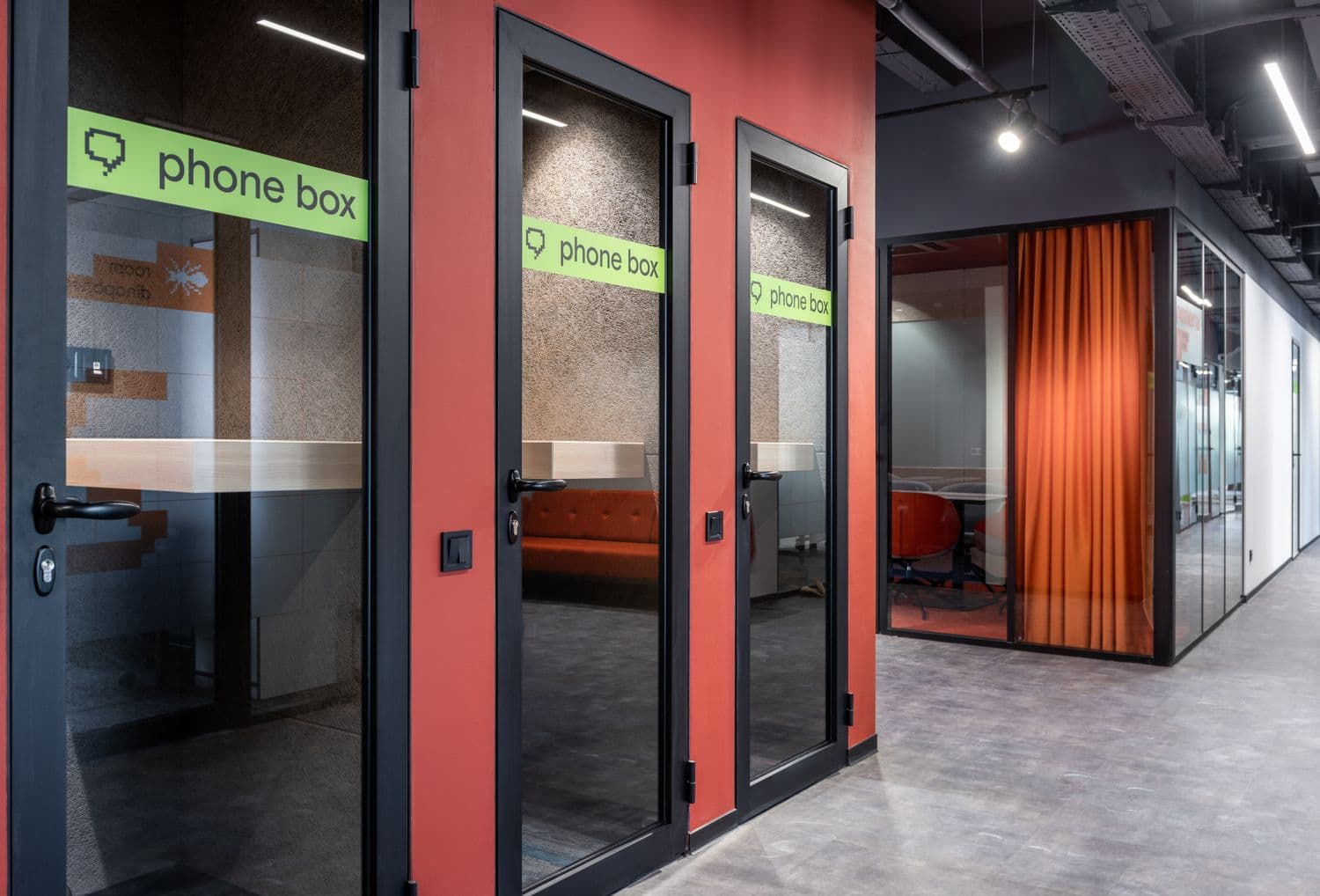
Privacy booths for offices are now the fastest-growing category in Australian commercial fitout, and the reason is simple. The return-to-office mandates are no longer a rumour. They are policy. The offices people are returning to were never designed for full capacity. Stemar Group has seen enquiries for privacy booths and pods increase by more than 60% year on year across Greater Sydney.
During the remote work years, many businesses stripped back partitions and leaned into open-plan office design. Desks spread out. Collaboration zones replaced meeting rooms. Layouts were optimised for 40 to 60% occupancy. That worked when half the team was at home.
Now everyone is back. The Robert Half 2025 Salary Guide confirms RTO mandates are accelerating across Australian professional services and industrial sectors. Research from the University of Sydney found that 50% of open-plan workers cite sound privacy as the single biggest source of workspace dissatisfaction. Google Trends data shows "office pods" at 94 out of 100 search interest in Australia. Safe Work Australia guidelines support acoustic privacy zones as a productivity and psychological safety measure.
This guide is the planning step before you buy anything.
Three Tiers of Office Privacy Solutions and When Each One Fits
Not every noise problem needs the same fix. Privacy solutions span a spectrum from light to deep, and choosing the wrong tier wastes money. The table below compares all three tiers by acoustic performance, cost, and use case.
| Solution type | Visual privacy | Acoustic (NRC) | Sound blocking (STC) | Typical cost | Best for |
|---|---|---|---|---|---|
| Screens & dividers | Yes | Low (0.2-0.4) | Negligible (<10) | $200-$800 per panel | Desk-level visual distraction |
| Acoustic partitions | Partial | Moderate (0.6–0.85) | Moderate (20–30) | $350-$750/lm | Team speech privacy zones |
| Phone booths & meeting pods | Full | High (0.85+) | High (30+) | $8,000-$50,000 + per pod | Calls, meetings, deep work |
Tier 1: Office privacy screens and dividers. Office privacy screens and office privacy dividers create visual barriers between desks. Privacy film office treatments do the same for glass partitions. These reduce line-of-sight distraction but do almost nothing for sound. If your problem is noise from phone calls and conversations, screens are a stopgap, not a solution.
Tier 2: Acoustic partition zones. An office privacy partition rated for acoustic performance sits in the middle ground. These are freestanding or semi-fixed panels that absorb and block sound transmission across a defined zone. They suit teams that need speech privacy without fully enclosed spaces. For a deeper look at acoustic ratings, see Stemar Group’s acoustic partition guide.
Tier 3: Office privacy booths and office meeting pods. This is the deepest privacy tier. Office privacy booths and office meeting pods are fully enclosed, acoustically rated spaces designed for phone calls, video meetings, focused deep work, or sensitive conversations. These deliver real, measurable speech privacy with NRC ratings of 0.85 or above and STC ratings of 30 or above.
One practical distinction worth noting early: freestanding pods are classified as furniture and typically require no council approval. Fixed partition installations in leased commercial premises may require building manager or council sign-off. That difference affects your timeline and your budget.
Matching the Right Pod to the Right Use Case
Knowing you need pods is the easy part. Knowing which type, how many, and where to put them is what most businesses get stuck on.
The matrix below maps each pod type to its primary use case, recommended NRC and STC ratings, and the sizing ratio that tells you how many you need for your floor.
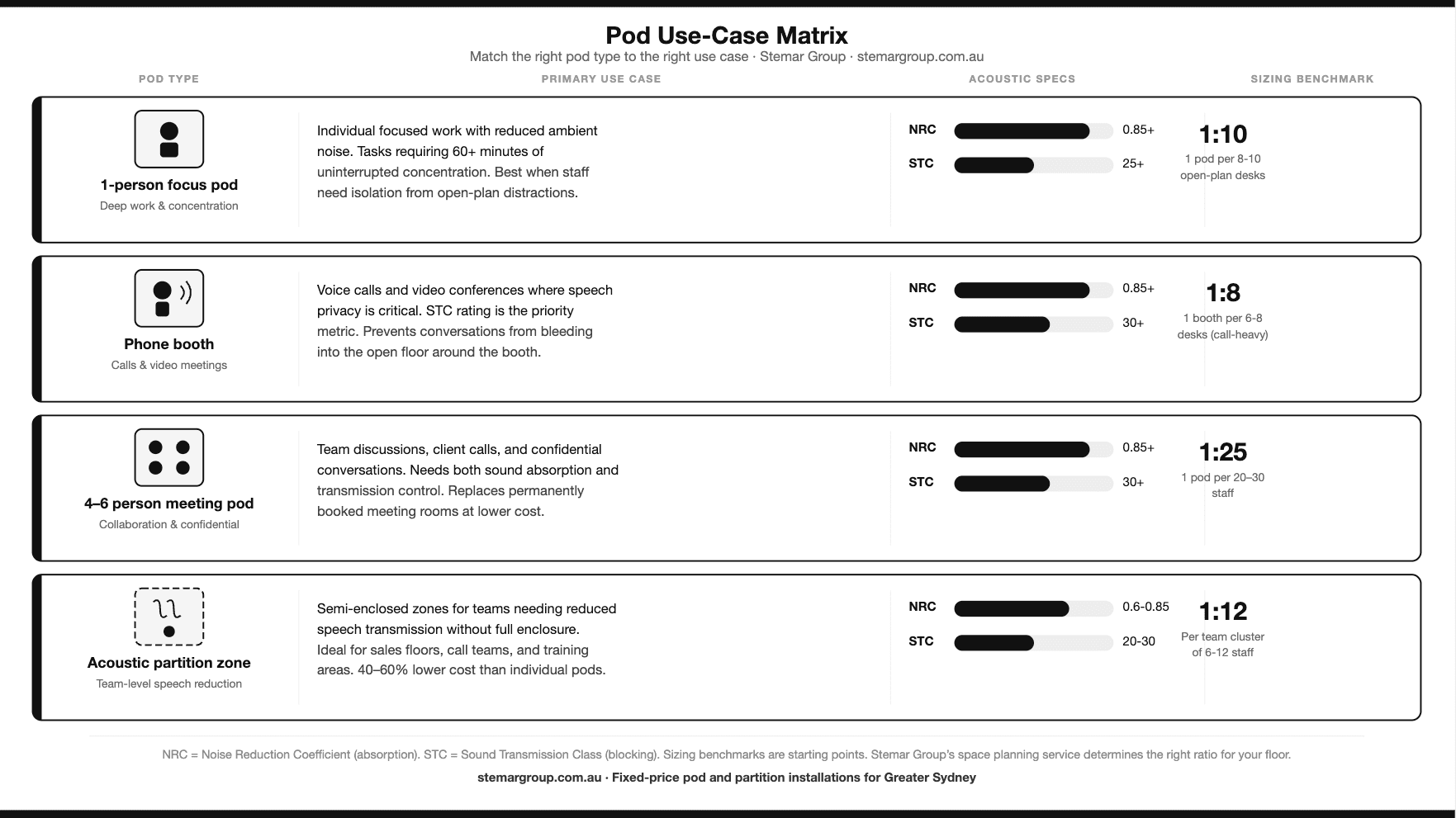
Each pod type below expands on a single row of the matrix, including the edge cases and team patterns that shift the sizing benchmarks for your specific floor.
1-person focus pods are for deep work and individual concentration. These need good absorption (NRC 0.85+) but do not require the highest sound-blocking ratings.
Single-person phone booths are for calls and video meetings. Speech transmission is the primary concern, so STC ratings matter most. Look for STC 30 or above.
4 to 6 person meeting pods handle collaborative sessions and sensitive conversations. These are one of several collaboration spaces in a hybrid office worth considering.
For sizing, a commonly cited benchmark is 1 focus booth per 8 to 10 open-plan desks. But that ratio is a starting point. Audit your current call and focus patterns first. If half your team is on calls for three or more hours a day, you need more booths. Stemar Group’s space planning service helps determine the right ratio for your floor.
The relevant Australian standard underpinning these acoustic design decisions is AS/NZS 2107, which provides recommended noise levels for different workspace types.
When Partitions Beat Pods
Fully enclosed pods are not always the right answer. Sometimes they are the expensive answer to a problem that partitions solve better.
Consider a sales team of eight who all make calls throughout the day. Eight individual phone booths occupy significant floor space and cost $64,000 to $120,000 at current Sydney prices. An acoustic-rated partition zone around that team can reduce speech transmission across the floor by 40 to 60% at a cost of about 1/4 of the pod cost, without the footprint of eight separate enclosures.
Acoustic partitions rated to NCC 2022 standards create semi-enclosed zones that dampen sound rather than fully blocking it. They are ideal for team huddles, training areas, or open-plan sections that just need less noise, not silence.
Partitions also offer something pods do not: reconfigurability. Modular acoustic partitions can move with your team as headcount changes or layouts evolve. For businesses expecting growth, that flexibility is a better long-term investment. Stemar Group’s acoustic office partitions are rated to NCC 2022 standards and designed for exactly this scenario.
Is the Layout the Real Problem?
Sometimes adding pods or screens is treating the symptom. If the underlying layout was designed for a different era of work, the better investment might be rethinking the floor plan entirely. Three signs a layout rethink is overdue:
- Every meeting room is permanently booked
- Staff are taking calls in stairwells or kitchens
- The ratio of collaborative to focused space does not match how your team actually works
Safe Work Australia's workplace design guidelines support matching the layout to actual work patterns, not to legacy floor plans. Stemar Group breaks down the trade-offs between open-plan vs partitioned office layouts in a separate guide. If your team splits time between office and remote, the hybrid office design guide covers the layout principles that make that work.
Installing Pods and Booths Without Shutting Down the Floor
Freestanding pods can typically be delivered and assembled in 2 to 4 hours per unit. No trades required. They arrive flat-packed or pre-assembled and go up in position while the team keeps working around them.
Partition-integrated solutions and larger meeting pods are different. They need fitout planning, electrical connections, and potentially data cabling. But with staged delivery and after-hours work, the floor stays operational.
The difference between a furniture retailer and Stemar Group is coordination. A furniture retailer drops a pod at your loading dock. A managed fitout provider coordinates the goods lift booking, the electrical connection, the building management approval, the fire compliance check for enclosed pods, and the phased install schedule so your team is not displaced.
Sydney-specific considerations matter here. CBD commercial leases typically require building management approval for anything beyond furniture. Goods lift access needs to be booked, sometimes 2 to 4 weeks in advance. Enclosed pods may trigger fire compliance requirements. Stemar Group manages all of this under one project manager. Staged delivery, after-hours installation where needed, and fixed-price quotes with no hidden surprises.
Frequently Asked Questions About Privacy Booths for Offices
What is the difference between a privacy screen and an acoustic booth?
A privacy screen blocks sight; an acoustic booth blocks sound. An office privacy screen creates a visual barrier between desks but does almost nothing for noise. An acoustic booth is a fully enclosed space rated for sound absorption (NRC 0.85+) and sound transmission blocking (STC 30+). If noise from calls and conversations is the problem, screens will not solve it.
How many privacy booths does our office need?
Plan for 1 focus booth per 8 to 10 open-plan desks as a starting point. The right number depends on how your team works. If most staff spend 2 or more hours per day on calls or need uninterrupted focus blocks, you will need a higher ratio. Stemar Group’s space planning service helps determine the right number for your floor.
Do privacy booths need council approval in Sydney?
Freestanding pods do not require council approval. They are classified as furniture. Fixed partition installations may require building manager or council approval in leased commercial premises. NCC 2022 and AS/NZS 2107 are the relevant standards for permanent installations.
How long does it take to install office pods?
Freestanding pods take 2 to 4 hours per unit. Partition-integrated solutions or multi-pod fitouts take 3 to 10 business days depending on scope, electrical requirements, and building access. Stemar Group manages phased installs to minimise disruption. Learn more about our office pods and meeting pods service for Sydney workspaces.
Can privacy booths be installed in a leased office?
Yes. Freestanding pods are non-structural and removable at lease end. Partition-based solutions may need landlord approval but can be designed for disassembly and relocation, reducing make-good exposure.
Are privacy booths better than traditional meeting rooms?
For 1 to 4-person conversations and calls, booths are typically faster to install (days vs weeks), lower in cost ($8,000 to $50,000 vs $25,000 to $55,000 for a built meeting room), and more flexible since they can be relocated. Traditional meeting rooms remain the better option for larger groups (6+), AV-intensive presentations, and permanent client-facing spaces.
Start with an Acoustic and Privacy Assessment
The right answer for your workspace might be pods, partitions, a layout rethink, or a combination. The only way to know is to assess the current space.
Stemar Group is based in Wetherill Park and serves Greater Sydney. You get direct contact with the owner, a fixed-price quote with no hidden surprises, and a project management approach that keeps your business running during installation. Contact Stemar Group to book a free acoustic and privacy assessment of your current workspace.