
You have signed a lease, or you are about to. The space is locked in, the rent clock is ticking, and somewhere between now and move-in day sits a long list of decisions you have not made yet. That gap can feel like a black box.
You are probably too big for a couple of tradies with a ute, but not big enough for the tier-one builders to return your call promptly. That middle ground is where projects stall, budgets blow out, and timelines drift.
This post is your office space planning roadmap. It covers every stage from lease signing to handover, from the client's side. Not a glossary of fitout types or a sales pitch for design trends. Just the decisions you need to make, in the order you need to make them, and what each one means for your cost, timeline, and ability to keep the business running. For businesses speaking with Stemar Group about an office fitout in Sydney, it is the practical roadmap between signing the lease and taking possession of a finished workplace.
Stage 1: Assess Your Space Requirements
Space assessment is the foundation of every planning decision that follows. Get this wrong and you will be chasing problems through every stage of the project. Every later design, budget, and programme decision depends on this first calculation.
Start with your current headcount. Then factor in where you expect to be in 12 months and where you want to be in three years. Office space planning that only accounts for today's team is office space planning you will redo sooner than you think.
Practical office space planning metrics to work with:
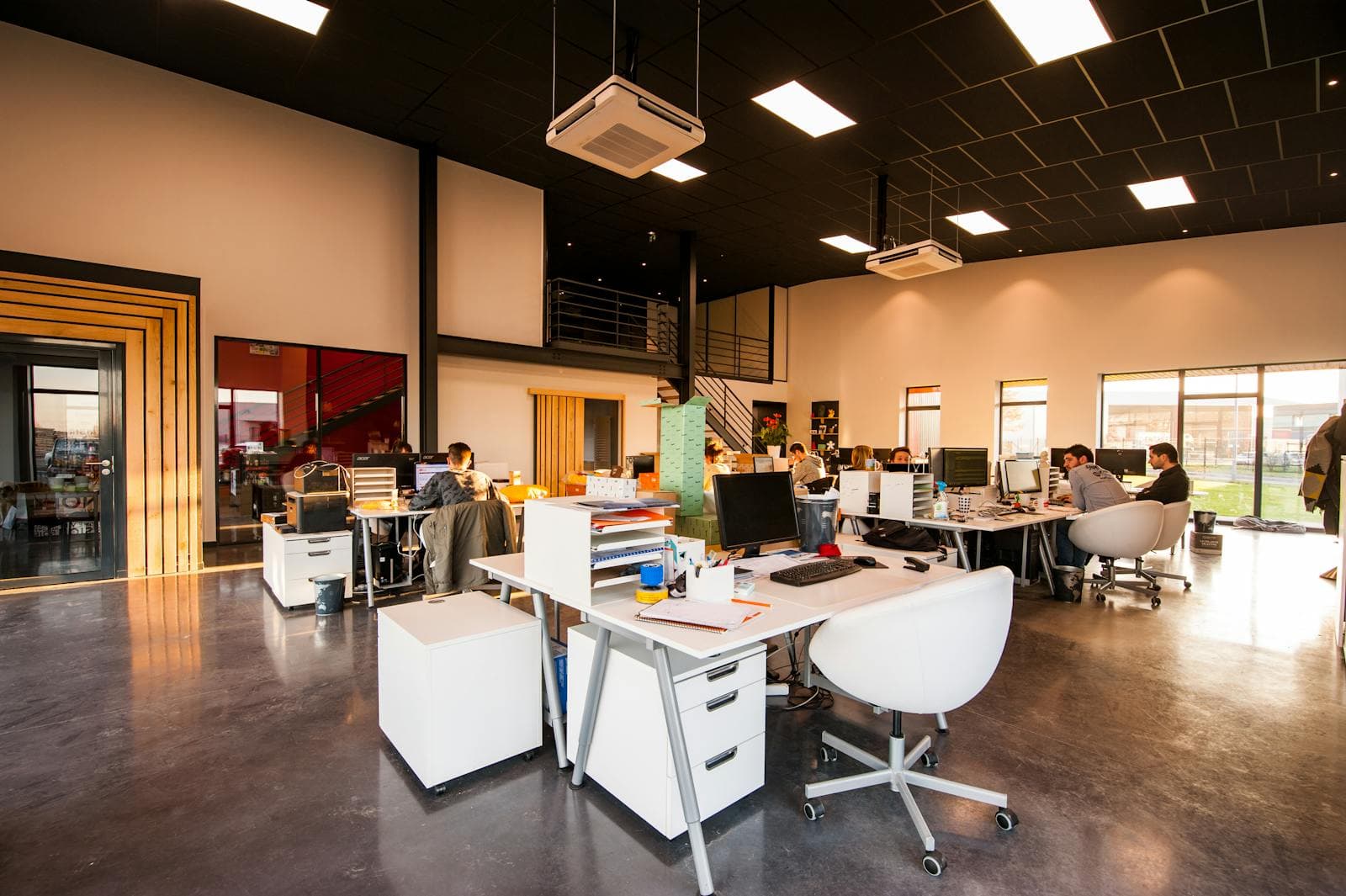
If you are leaning toward an open plan office fitout, use 8 to 12 sqm per employee as your starting point. For partitioned offices, plan for 12 to 15 sqm per person. These figures cover desk space and immediate work area but not shared zones.
On top of that, allocate 30 to 40 percent of your total usable area for circulation. That includes corridors, breakout zones, and movement paths between workstations. These benchmarks are consistent with nationally recognised workplace design principles, but because this article is written for Sydney and NSW projects, readers should cross-check layout, facilities, and consultation duties against SafeWork NSW workplace facilities guidance and SafeWork NSW consultation requirements as well as project-specific approval conditions.
Here is a quick calculation to sanity-check your lease. Take 30 employees at 10 sqm each. That gives you 300 sqm of workstation area. Add 35 percent for circulation and you land at roughly 405 sqm total. If your lease is for 350 sqm, you have a problem to solve before you brief a designer.
The table below shows how that calculation scales, using 10 sqm per person and 35 percent circulation as a simple planning benchmark.
| Headcount | Sqm per person | Workstation area | Circulation (35%) | Total required |
|---|---|---|---|---|
| 20 | 10 sqm | 200 sqm | 70 sqm | 270 sqm |
| 30 | 10 sqm | 300 sqm | 105 sqm | 405 sqm |
| 50 | 10 sqm | 500 sqm | 175 sqm | 675 sqm |
The regulatory minimum of 4.5 sqm per person is exactly that, a minimum. Practical floor plan for office space targets sit well above it. Plan for comfort and productivity, not just compliance.
Stage 2: Build Your Design Brief
A design brief is a document that tells your designer and builder what you need the space to do. Not what colour the walls should be. Not which furniture catalogue you like. What the space needs to achieve for the people who work in it every day.
A good brief covers five things:
- Headcount projections: Current numbers and planned growth.
- Workflow requirements: Who needs to sit near whom. How often teams meet. Where clients visit.
- Brand expression: Colours, signage, and the impression your client-facing areas need to make.
- Technology needs: Data points, AV setups, server rooms, and power requirements.
- Special requirements: Labs, workshops, high-security zones, or anything outside a standard office planning space layout.
One thing that is often missed: consulting your employees and health and safety representatives during this stage is a legal requirement, not a nice-to-have. In NSW, workers must have an opportunity to express their views and contribute to decisions that affect their health and safety, including workplace layout and design changes. SafeWork NSW explains that duty clearly in its duty to consult guidance.
Workstation design must allow comfortable working postures with adequate clearance for movement and task performance.
Getting the brief right prevents costly redesigns later. A vague brief forces your designer to make assumptions. Assumptions become variations. Variations cost money and time. This is one reason Stemar Group pushes clients to lock the brief before quotes are requested.
If you want a team to handle design and planning together, see Stemar Group's fitout design and planning services.
Stage 3: Set a Realistic Budget
Budget setting comes after the brief, not before. The brief defines scope. Scope drives cost. Setting a number before you know what you need is guesswork.
At this stage, establish a range rather than a fixed figure. Fitout costs vary significantly based on layout complexity, material selections, and compliance requirements. A partitioned layout costs more per sqm than open plan. Imported materials extend lead times and add freight costs. Every planning decision has a downstream price tag.
Commonly forgotten budget items:
- Council and approval fees
- Professional fees for architects and engineers
- Furniture and IT infrastructure
- Make-good obligations at the end of your lease
- Contingency for unforeseen site conditions
The most reliable way to control cost is to lock in scope early and get a fixed-price quote based on complete documentation. Incomplete scope leads to provisional sums, and provisional sums lead to surprises at invoice time.
For a detailed office fitout cost breakdown including per-sqm ranges, see Stemar Group's cost guide.
Stage 4: Address Compliance and Approvals Early
Compliance is not a box to tick after the design is finished. It needs to be woven into the design stage. Discovering a fire safety issue or an accessibility shortfall after construction starts means rework, delay, and cost.
At a high level, your project will need either a Development Application (DA) through council or a Complying Development Certificate (CDC) through a private certifier. A DA takes longer but covers a wider range of projects. A CDC is faster but only available if your project meets specific criteria. For NSW projects, use the NSW Planning Portal as an authority source when you are comparing the DA and CDC pathways, and use the National Construction Code when checking fire safety and accessibility requirements during design.
Key office space planning standards to address during design:
- Fire safety: Exits, sprinklers, detection, and compartmentation should align with the National Construction Code and the approved fire strategy for the building.
- Accessibility: DDA compliance for entries, amenities, and circulation should be reviewed alongside the National Construction Code and the certifier's requirements.
- Mechanical ventilation: Adequate airflow for occupied spaces.
- Acoustics: Noise levels and acoustic design must be considered in open plan environments to prevent distraction and fatigue.
- Lighting: Natural and artificial lighting must be adequate for tasks performed without causing glare or eye strain.
Council requirements vary across Greater Western Sydney. What flies in Parramatta may not pass in Penrith. Stemar Group's commercial fitout services in Sydney cover council liaison across Greater Western Sydney.
Stage 5: Prepare for the Quoting Process
Before you approach contractors, make sure you have your documentation in order. Vague scope documents produce vague quotes, and vague quotes produce disputes.
What you need ready:
- A finalised or near-final design brief
- Floor plans with dimensions and layout
- A budget range, not a single number
- A target move-in date
The goal is to get like-for-like quotes. Every contractor should be pricing the same scope so your comparisons are meaningful. If one quote is 30 percent lower than the others, they are either missing something or making assumptions you have not agreed to.
If you are starting from an empty shell, Stemar Group's new office fitout service covers everything from base build to handover. For a full evaluation framework, see our guide on how to choose an office fitout company.
Stage 6: Understand Your Timeline
Timelines depend on project size, complexity, and how much planning you have done upfront. Here are typical construction durations to use as a starting point:
| Project size | Typical construction duration |
|---|---|
| Under 200 sqm | 4 to 6 weeks |
| 200 to 500 sqm | 8 to 12 weeks |
| 500+ sqm | 12 to 20 weeks |
These are construction timelines only. Add 4 to 8 weeks for design and approvals on top. If your project requires a DA, council approval alone can take much longer than the construction itself.
The most common mistake is underestimating lead times. Imported joinery, custom glazing, and specialist materials can add 6 to 10 weeks. If a material is not ordered early, it does not matter how fast your builder works on site.
Trade scheduling is where projects succeed or fail. Electricians, plumbers, data cablers, and painters need to be sequenced correctly. One trade running late pushes every trade behind it.
For complex fitouts, Stemar Group project management keeps trades sequenced and the timeline on track.
Staged delivery and after-hours work can reduce disruption for businesses that need to keep operating during construction. For a detailed look at what happens during the build itself, see our construction and fitout process guide.
Do not treat practical completion as the end of the journey. Handover should include a defects list, warranties, manuals, certifications, and confirmation that building services have been tested and commissioned. Your contract should also spell out the defects liability period so any post-handover issues are rectified promptly after move-in.
Planning for Minimal Disruption
For growing businesses, shutting down operations for weeks is rarely an option. Revenue does not pause because your fitout is underway.
Practical strategies to keep the business running:
- Phased fitouts: Complete one floor or zone at a time while the rest of the office stays operational.
- After-hours and weekend work: Noisy trades scheduled outside business hours to minimise impact on your team.
- Temporary relocation: Move critical teams to a short-term space or remote setup during peak construction.
- Communication plans: Keep staff informed on timelines, noise periods, and access changes so there are no surprises.
Disruption planning should be part of your design brief from day one. If you need the business running during construction, your builder needs to know that upfront so they can plan access routes, noise management, and staging areas. This is not something to raise halfway through the build.
Based in Wetherill Park, Stemar Group understands the operational realities of businesses across Western Sydney. Office space planning consultants who ignore operational continuity are solving half the problem.
Start Your Fitout Plan with a Free Consultation
You now have a clear picture of what sits between signing a lease and moving in. Six stages, each one feeding the next.
Good planning reduces the three things growing businesses fear most: cost blowouts, timeline slippage, and operational disruption. The earlier you start, the more control you have.
The logical first step is a conversation. Bring your lease details, your headcount, and a rough timeline. You will walk away with a clear picture of scope, budget range, and next steps. With Stemar Group, you deal directly with the owner, and every quote is fixed-price with no hidden surprises.
Ready to get started? Book a free consultation and Stemar Group will map out your fitout plan together. Learn more about the fitout design and planning process.