

Sydney office fitout costs range from $1,200 to $3,500+ per square metre in 2026. Where you land in that range depends on the fitout tier, your Sydney precinct, and the complexity of the build. A straightforward open plan layout in Western Sydney sits at the lower end. A fully custom, client-facing workspace in the CBD pushes well past the upper end.
This guide covers office fitout costs specifically. If you are pricing a retail, hospitality, or industrial space, our commercial fitout cost guide breaks down those categories separately.
Below, we walk through three pricing tiers, a per-employee budgeting lens, precinct-level pricing differences across Sydney, and a practical framework for locking in your office fitout cost before the next round of increases. The goal is to give you numbers you can actually plan around.
Office Fitout Costs by Tier: Basic, Mid-Range, and Premium
Not every office needs the same level of finish. The average cost to fitout an office depends heavily on which tier matches your business needs. Here is how each one breaks down.
| Tier | Price Range (per sqm) | Finishes & Features | Typical Use Case |
|---|---|---|---|
| Basic | $1,200 - $1,800 | Painted plasterboard, carpet tiles, standard LED lighting, basic HVAC, minimal joinery | Teams prioritising function over aesthetics; low client foot traffic |
| Mid-range | $1,800 - $2,500 | Vinyl plank or polished concrete, standard AV/IT infrastructure, custom joinery at reception and meeting rooms | Growing businesses wanting a professional workspace without premium spend |
| Premium | $2,500 - $3,500+ | Custom joinery throughout, high-end materials, acoustic treatment, integrated technology, branded environments | Client-facing offices where workspace is part of the brand: law firms, financial services, creative agencies |
Basic: $1,200 to $1,800 per sqm
This tier covers a functional open plan layout with standard commercial-grade finishes. Think painted plasterboard walls, carpet tiles, basic LED lighting, and standard HVAC. Joinery is minimal. Workstations are practical, not custom.
This suits businesses that prioritise function over aesthetics. If your team works primarily from desks and you do not host clients in the office regularly, basic delivers a clean, professional workspace without overcapitalising.
Mid-range: $1,800 to $2,500 per sqm
The most common tier for growing businesses. You get a mix of open plan and enclosed spaces, quality finishes like vinyl plank or polished concrete, standard AV and IT infrastructure, and some custom joinery for reception areas or meeting rooms.
This is where most businesses land when they want a workspace that looks and feels professional without pushing into premium territory. It handles the balance between collaboration zones, private offices, and meeting rooms well.
Premium: $2,500 to $3,500+ per sqm
Custom joinery throughout, high-end finishes, integrated technology, acoustic treatment, and branded environments. This tier suits client-facing offices where the workspace is part of the brand. Law firms, financial services, and creative agencies often sit here.
At this level, every detail is specified. Lighting design, material selection, and spatial planning are all tailored to the business. The average office fitout cost per square metre at premium tier reflects that level of design intent and build precision.
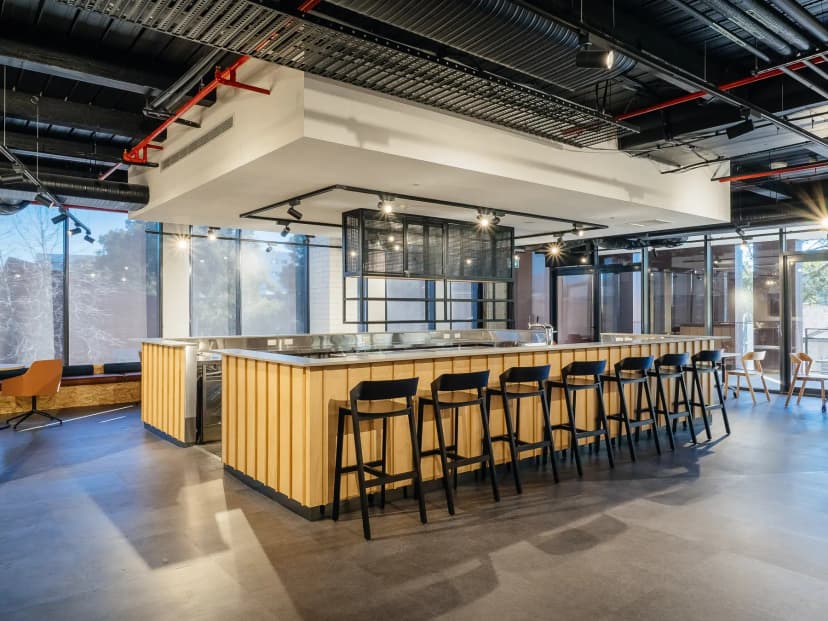
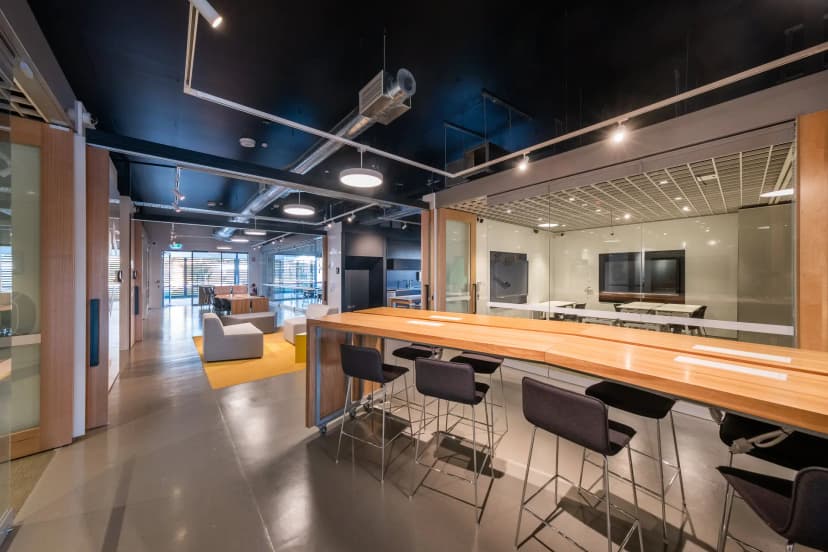
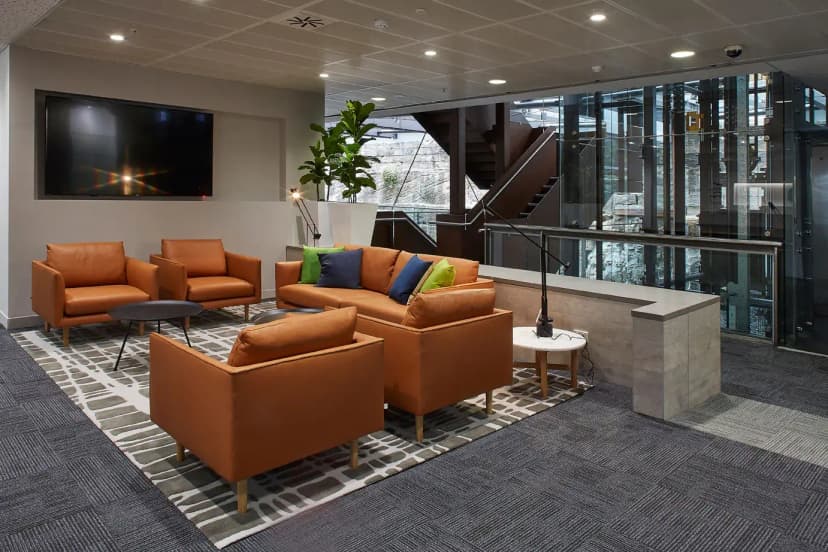
For a visual sense of what each tier looks like in practice.
Office Fitout Cost per Employee
Square metre pricing is useful, but many business owners think in headcount. If you are planning for a team of 20 or 50, cost per employee gives you a faster way to frame the total investment.
Office fitout costs per employee typically range from $18,000 to $45,000. The variation comes from two factors: how much space you allocate per person and which fitout tier you choose.
Workspace density varies. A tighter layout runs around 10 sqm per person. A more generous setup with private offices and breakout areas pushes to 15 sqm per person. Most mid-market offices sit around 12 sqm per person.
Here is a worked example. A 30-person office at 12 sqm per person gives you 360 sqm of floor area. At mid-range pricing ($1,800 to $2,500 per sqm), the total lands between $648,000 and $900,000, or roughly $21,600 to $30,000 per employee.
| Team Size | Floor Area* | Basic ($1,200-$1,800/sqm) | Mid-range ($1,800–$2,500/sqm) | Premium ($2,500-$3,500/sqm) |
|---|---|---|---|---|
| 20 people | 240 sqm | $288k - $432k / $14,400 - $21,600 per person | $432k - $600k / $21,600 - $30,000 per person | $600k - $840k / $30,000 - $42,000 per person |
| 30 people | 360 sqm | $432k - $648k / $14,400 - $21,600 per person | $648k - $900k / $21,600 - $30,000 per person | $900k - $1.26m / $30,000 - $42,000 per person |
| 50 people | 600 sqm | $720k - $1.08m / $14,400 - $21,600 per person | $1.08m - $1.5m / $21,600 - $30,000 per person | $1.5m - $2.1m / $30,000 - $42,000 per person |
* Assumes 12 sqm per person (typical mid-market density). Adjust for your actual space allocation per person.
Headcount planning is one part of the broader fitout planning process. Our office fitout planning guide covers space allocation, workflow mapping, and brief development in detail.
Sydney Precinct Pricing: CBD, North Sydney, and Western Sydney
How much does an office fitout cost? In Sydney, the answer shifts depending on which part of the city you are in.
Sydney CBD fitouts typically cost 15 to 25% more than equivalent projects in fringe suburbs and Western Sydney. That premium comes from restricted site access, loading dock limitations, mandatory after-hours work, and higher base building compliance requirements. Building management fees and coordination with other tenants add further cost and complexity.
North Sydney and the broader North Shore sit in the middle of this range, typically 5 to 10% above Western Sydney rates and 10 to 15% below the Sydney CBD. The North Sydney precinct offers fewer mandatory after-hours work requirements and better site access than the CBD core, while still providing a prestige business address. It is an increasingly common choice for professional services, financial services, and technology firms that want a lower fitout cost without moving to a suburban precinct.
These precinct cost differentials are tracked in JLL’s Sydney Office Market research, which publishes submarket-level construction cost comparisons across Sydney precincts.
Western Sydney precincts like Wetherill Park, Smithfield, and the Parramatta corridor offer tangible logistics advantages. Easier site access means faster material deliveries. Fewer building management restrictions reduce coordination overhead. Proximity to suppliers in the Smithfield-Wetherill Park Industrial Estate cuts transport costs.
Stemar's base in Wetherill Park puts us in the heart of Sydney's industrial heartland. For businesses looking at office fitouts in Western Sydney, that proximity translates to practical cost and scheduling advantages.
See how we manage office fitouts across Sydney, from CBD to Western Sydney.
Why Fitout Costs are Stabilising
After years of escalation driven by supply chain disruption in 2022 and 2023, office fitout costs have stabilised nationally, as tracked by the ABS Construction Activity index and confirmed by Cushman & Wakefield’s Fit Out Cost Guide 2025/26 confirms this trend across Australian capital cities, including Sydney.
That said, the window may not stay open. According to the same research, 83% of contractors expect slight price increases in the next six months. Materials pricing has levelled off, but labour demand remains firm across commercial construction in Sydney.
The practical takeaway: fitout cost stabilisation makes 2026 a relatively predictable time to plan and commit. Quotes issued now are more reliable than they were during the disruption period. Project timelines are more accurate. If you are in the research phase, moving to a fixed-price contract sooner rather than later protects your numbers against the next round of increases.
Cost Drivers You Can Actually Control
Some cost factors are fixed by your building and location. Others are decisions you make during planning. Here are the ones worth your attention.
- Layout choice: Open plan is typically the most cost-effective layout per square metre. Partitioned offices require more walls, doors, and services distribution. If your workflow allows it, an open plan office fitout reduces build cost and often improves space efficiency.
- Design complexity: Custom joinery, curved walls, and bespoke finishes add cost at every stage. A clear, detailed design brief upfront reduces variations during construction. Investing in office fitout design and planning before construction starts is one of the most effective ways to control your total spend.
- Compliance requirements: DA, CDC, and OC processes add 8 to 12% to base fitout costs (based on Stemar project data). The pathway you choose affects both cost and timeline. Local council approval expertise matters here, particularly in Western Sydney where council requirements vary between local government areas.
- Location within Sydney: As covered above, CBD versus Western Sydney creates a 15 to 25% cost differential on comparable projects. This is largely fixed by your lease, but worth factoring into site selection if you have not committed yet.
What is Included (and excluded) in a Fitout Quote
Understanding what sits inside and outside a fitout quote is essential for comparing office fitout costs per m2 on a like-for-like basis.
A typical fitout quote covers demolition, partitioning, flooring, painting, electrical, data cabling, HVAC modifications, lighting, and project management. These are the core build elements, coordinated under one project manager to keep trades sequenced and the program on track.
Common exclusions that cause budget blowouts include:
- Furniture and workstations
- IT hardware and AV equipment
- Signage and wayfinding
- Make-good provisions at lease end
- Landlord-required base building works
A lower headline number often excludes items that another quote includes. Before comparing, line up the inclusions side by side. Ask each provider for a detailed scope breakdown. Fixed-price quotes with clear inclusions and exclusions protect you from surprises during the build.
New Office Fitout versus Refurbishing an Existing Space
Starting from a bare shell costs more than refurbishing an existing fitted space. A new office fitout from shell includes base building works that a refurbishment does not: fire services, main electrical distribution, HVAC trunk lines, and amenities like kitchens and bathrooms.
Refurbishing an existing space is typically 20 to 40% less than a shell fitout because that base infrastructure is already in place. However, demolition and make-good of the previous tenant's fitout adds cost. Older buildings may also require upgrades to meet current compliance standards, which can narrow the gap.
The right approach depends on your lease terms, the condition of the existing space, and your timeline. Both pathways deliver affordable office fitouts when scoped and managed properly.
How to Lock in Your Office Fitout Cost
Moving from research to a locked-in contract does not need to be complicated. Here is a practical framework.
- Define your brief: Document your headcount, workspace requirements, must-have features, and budget range. The clearer the brief, the more accurate the quote.
- Get a design concept: A design concept translates your brief into a spatial plan with layout, finishes, and services mapped out. This is the foundation for accurate pricing.
- Request a fixed-price quote: A fixed-price quote based on a defined scope protects you from cost creep. Ensure it details inclusions and exclusions clearly.
- Review inclusions and exclusions: Compare against your brief. Flag anything missing. Confirm who is responsible for furniture, IT, signage, and make-good.
- Sign and lock in pricing: With 83% of contractors expecting price increases in the next six months, a signed contract at today's pricing is your best protection against escalation.
Growing businesses often find themselves in a gap: too complex for small operators, not large enough to get attention from tier-one contractors. That middle ground is exactly where Stemar operates. Multi-trade coordination under one project manager, staged delivery and after-hours work available, and direct contact with the people running your project. See our Sydney office fitout services for how we manage that process.
Every office is different. Get an accurate quote for your specific space and requirements.