
If you have already decided your workspace needs defined rooms instead of an open floor plate, the upstream question of an open-plan vs partitioned office layout is behind you. This guide picks up where that decision ends. It covers how to specify office partition walls with doors for a commercial fitout, including door integration choices that account for 30 to 40% of the total wall cost.
You are now specifying the build. The question is no longer "do we need walls?" but "what kind of walls, and how do we integrate doors?" That is a construction decision, and it deserves construction-grade guidance.
This guide is written for mid-market industrial and commercial businesses across Sydney. You are too complex for a handyman with a stud gun, and too small for a Tier 1 builder to return your call promptly. You sit in the middle, and that is exactly where Stemar Group works every day. Based in Wetherill Park in the heart of the Smithfield-Wetherill Park Industrial Estate, the advice here comes from 20+ years of fitout delivery on real sites, not a furniture catalogue.
Partition Walls vs Full-Height Walls
The term "partition wall" gets used loosely. Desk screens, freestanding dividers, and full-height demountable systems all get lumped together. This guide draws a clear line.
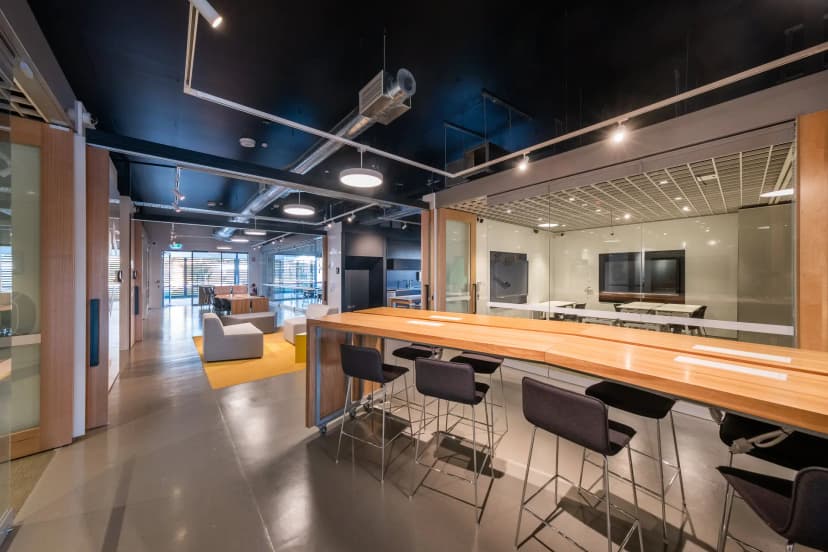
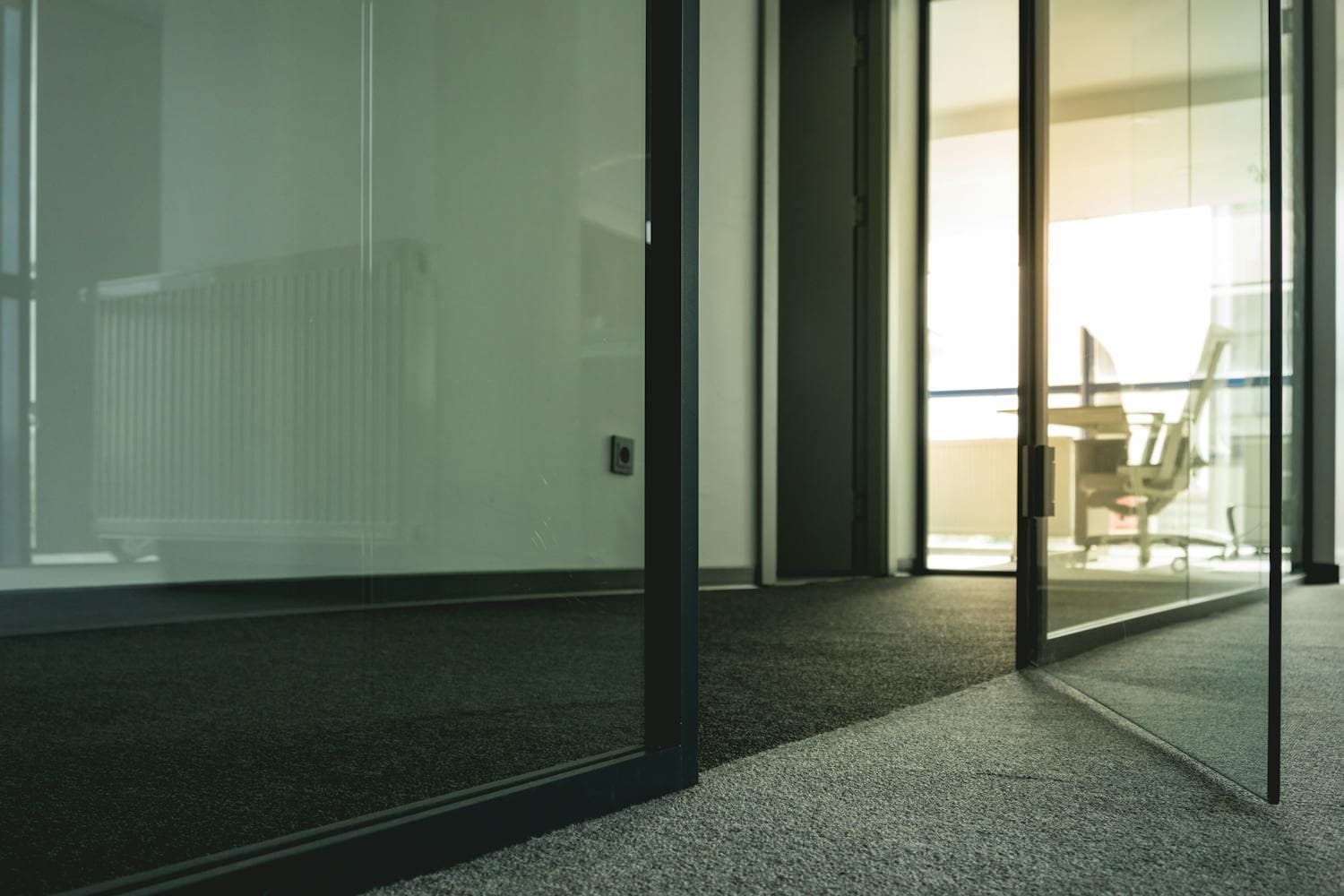
Office partition walls with doors are full-height demountable systems, typically aluminium-framed and non-load-bearing, designed to be relocated or removed without damaging the base building. They accept integrated door assemblies and can include glazed panels.
Full-height constructed walls mean traditional stud-and-plasterboard construction, permanently fixed, capable of achieving fire-resistance levels (FRL) and higher acoustic ratings. These behave like building elements.
Glazed partition systems with acoustic seals and solid kick panels can close the performance gap. Hybrid approaches are common, and a good fitout contractor will recommend the right mix for each room rather than push a single product.
Demountable interior office partition walls are non-structural and reversible. Constructed walls may require landlord consent and trigger make-good obligations at the end of the lease.
When to Choose Partition Walls with Doors
Demountable office partition walls suit specific scenarios. If your lease is under five years, your team is growing by 15% or more annually, or your layout may need to change within three to five years, partitions give you flexibility that constructed walls cannot.
Common use cases include team collaboration zones, flexible meeting rooms, project rooms, and internal offices where speech privacy is desirable but not critical. They also work well in spaces where you want natural light to flow through glazed panels while still defining separate rooms.
Most partition systems accept single swing doors, double doors, and sliding doors. Glazed doors maintain sightlines. Solid-core doors improve acoustic performance by 8 to 12 Rw points over hollow-core alternatives. Frame types range from aluminium to steel to timber-look finishes, and the choice affects both aesthetics and Rw rating at the door opening.
The diagram below compares all five door types side by side, showing how each option affects acoustic performance, cost per opening, and use case fit within a demountable partition frame.
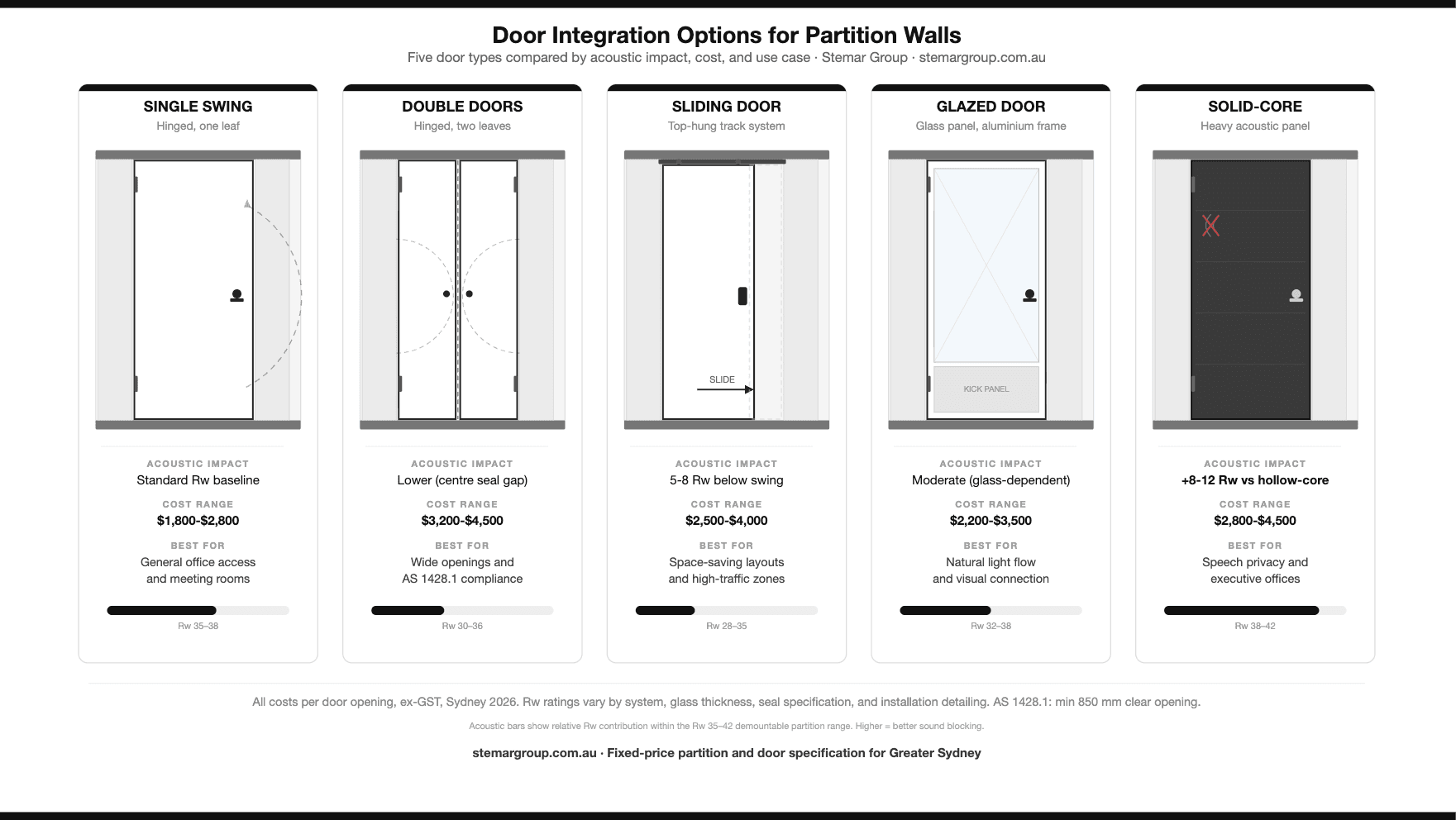
The cost and Rw ranges above are starting points; your final specification will depend on the partition system, glass thickness, seal detail, and the number of openings across the wall run.
Adding doors to a partition system incurs a $1,800 to $4,500 premium per opening over plain panels, depending on door type, frame, hardware, and acoustic seal specification. The door assembly typically represents 30 to 40% of the total wall run cost. Your contractor should break this out clearly in the quote so you can make informed trade-offs between the number of doors and your budget.
AS 1428.1 requires a minimum 850mm clear opening width for accessible doorways in commercial premises. This must be confirmed at specification stage, because not every partition system accommodates it without a wider frame module.
One operational advantage often overlooked: partition walls with doors can be installed in stages or after hours, with no wet trade, no extended drying time, and minimal dust. For leased Sydney premises, demountable partition systems with doors are reversible at lease end, avoiding make-good costs.
For more office partition wall ideas tailored to your specific use case, see how Stemar Group delivers office partition services across Sydney with minimal disruption to operations.
When you need a full-height constructed wall instead
Some rooms need a constructed wall. No partition system, however well specified, will satisfy every requirement.
Client-facing meeting rooms requiring genuine speech privacy need Rw 45 or above. HR offices where sensitive conversations happen need the same. Executive offices, reception areas, and tenancy demarcation walls all typically call for constructed walls.
Fire compliance is the other trigger. Internal walls forming a fire-isolated corridor or separating tenancies in a Class 5 (office) or Class 8 (industrial) building may require FRL ratings under the National Construction Code. A standard demountable partition system will not satisfy these requirements without certified fire-rated components, and those components are not always available in every system.
Constructed walls also integrate more easily with building services. Electrical, data, and HVAC can be routed through the wall cavity and detailed properly at junctions.
The trade-offs are real. Constructed walls cost 40 to 60% more upfront than equivalent demountable systems. Installation takes 2 to 3 times longer and generates more disruption: framing, plasterboard, stopping, painting, and potentially wet trades. A DA or CDC may also be required if the works affect the building’s fire compartmentation. For detailed cost benchmarks, see Stemar Group’s office partition cost guide for Sydney.
Acoustic Performance
When your contractor quotes on office partition walls, ask for the Rw rating of the proposed system. If they cannot provide it, that is a red flag. The benchmarks to ask about:
- Partition screens (desk height): Rw 20 to 30
- Full-height demountable partitions with doors: Rw 35 to 42
- Constructed walls with insulation: Rw 45 to 55+
NCC 2022 Section F7 sets sound insulation requirements for walls between sole-occupancy units and between units and common areas. In a multi-tenancy building, the walls separating your tenancy from the next may need to meet these requirements. Internal walls within your own tenancy are generally not regulated for acoustics, but that does not mean performance does not matter to your people.
Detailing determines performance. A poorly sealed junction, an unsealed services penetration, or a gap above the ceiling tile will degrade any wall’s acoustic rating by 5 to 15 Rw points. A well-detailed demountable partition can outperform a poorly built stud wall. Ask your contractor how they handle junctions, head tracks, and door seals, not just what panel they are using. For deeper detail, see Stemar Group’s acoustic office partitions guide.
Fire Ratings and Compliance
Not every internal wall needs a fire rating. But when it does, getting it wrong is not a minor issue.
Fire compliance is triggered in specific scenarios: tenancy boundary walls, walls forming fire-isolated corridors, walls around fire-isolated stairwells, and any wall that changes the building’s fire compartmentation. These situations require walls with certified FRL ratings as specified in NCC Volume 1.
Most standard demountable partition systems do not carry FRL ratings. Some manufacturers offer fire-rated partition components, but these must be certified and installed to the tested configuration. Do not assume a partition system will satisfy BCA requirements without checking.
Your fitout contractor and building certifier should confirm compliance before construction starts. If a DA or CDC is required, factor 4 to 8 weeks into your programme. Stemar Group has experience working with local councils across Greater Western Sydney. For a complete overview, see the office fitout compliance NSW guide.
Cost, lease length, and the make-good question
The cost comparison between partitions and constructed walls is not just about the install price. It is about total cost across the lease.
Partitions are 40 to 60% lower in upfront cost and install 2 to 3 times faster. A typical partition wall run with doors can be completed in 3 to 7 days, not weeks. At lease end, you remove them and walk away clean. Make-good costs for constructed walls in Sydney commercial tenancies range from $20,000 to $80,000, depending on the scope and original specification. Demountable partitions avoid this entirely.
Constructed walls cost more upfront and take longer to build. But if you are on a long lease with a stable layout, the higher acoustic and fire performance may justify the investment. The annual occupancy cost can favour constructed walls on a 10-year lease.
In most Australian commercial leases, fixed or structural internal walls require landlord written consent. Demountable partitions typically do not. If you have not checked your lease, do it before you brief your contractor.
Short lease or uncertain growth? Favour partitions. Long lease with stable operations? Constructed walls are worth the conversation. Stemar Group provides fixed-price quotes with no hidden surprises, so you can compare the two options on a like-for-like basis.
Decision Framework: Partitions vs Constructed Walls by Use Case
The comparison below shows how partition walls and constructed walls perform across the five specification metrics that matter most for a commercial fitout in Sydney.
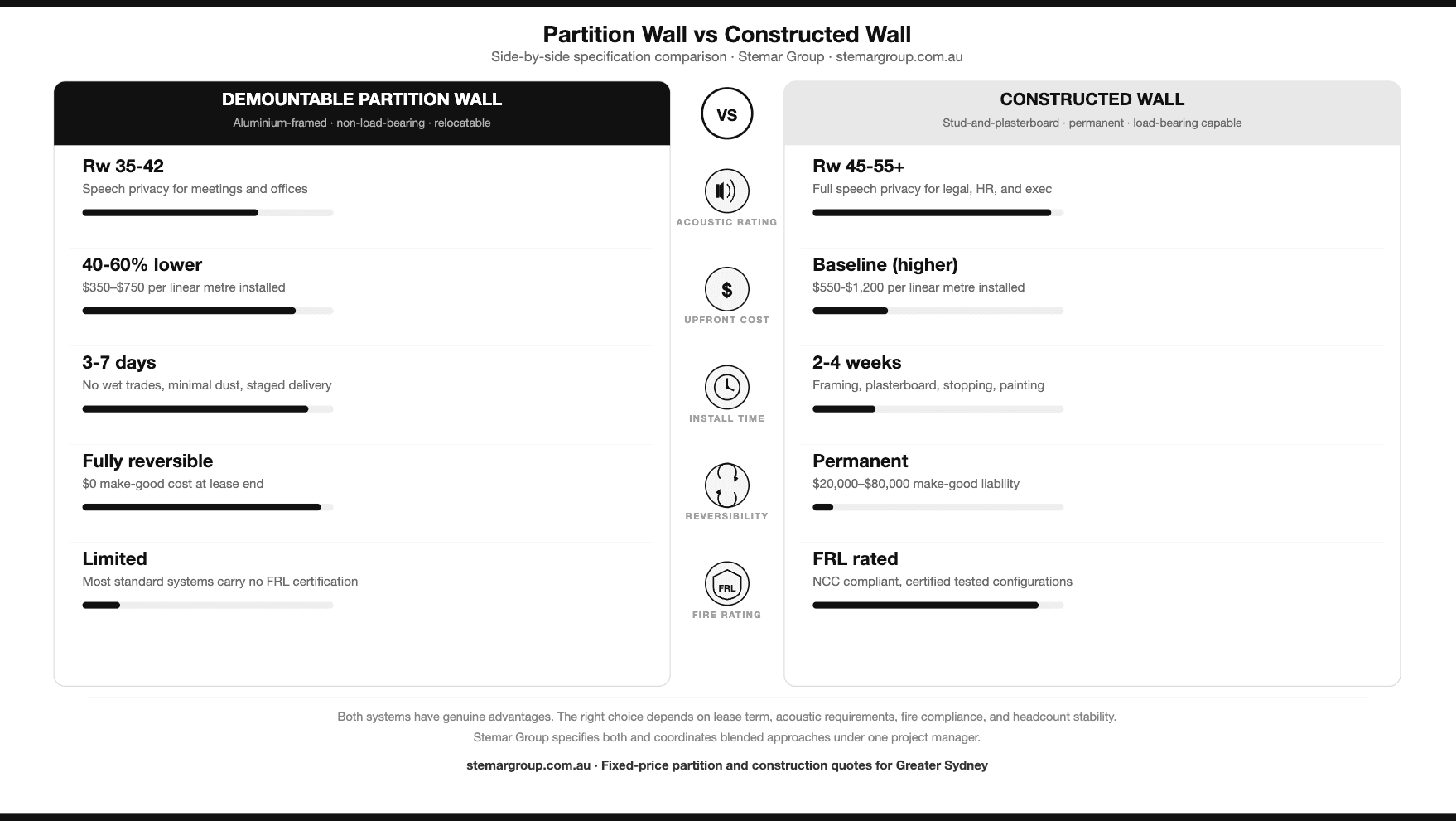
The table below maps these trade-offs to specific room types, so you can match the right wall system to each use case on your floor plan.
Use this table to guide your specification. These are reliable starting points for office wall partition ideas.
| Use case | Recommended | Rw range | Fire rating needed? | Reversible? |
|---|---|---|---|---|
| Team collaboration room | Partition with doors | 35-42 | Rarely | Yes |
| Flexible meeting room | Partition with doors | 35-42 | Rarely | Yes |
| Client-facing meeting room | Constructed wall | 45-55 | Check tenancy boundary | No |
| Executive office | Constructed wall | 45-55 | Rarely | No |
| HR / sensitive discussions | Constructed wall | 45-55 | Rarely | No |
| Reception area | Constructed wall | 45-55 | Often (exit path) | No |
| Break room / kitchen | Either | 35-45 | Check corridor adjacency | Depends |
All door openings must comply with AS 1428.1: a minimum clear opening width of 850 mm for accessible doorways.
Choose a partition system if your lease is under five years, your layout may change, you want to avoid make-good costs, or you need staged installation with minimal disruption.
Choose a constructed wall if you need Rw 45 or above, fire-rated separation, integration with building services, or a permanent tenancy boundary.
Frequently Asked Questions About Office Partition Walls with Doors
How do demountable partitions compare to plasterboard stud walls?
Demountable partitions cost 15 to 25% more upfront but install 2 to 3 times faster and avoid $20,000 to $80,000 in make-good costs at lease end. Plasterboard delivers higher acoustic and fire performance (Rw 45+) but cannot be relocated and typically requires landlord consent. For leases under seven years, demountable typically costs less over the full lease term.
Do office partition walls need council approval in Sydney?
Demountable partition systems generally do not require council approval because they are non-structural and reversible. Constructed walls may require a DA or CDC if they affect fire compartmentation, change the use classification, or impact egress paths. Always check with your fitout contractor and building certifier before construction begins.
Can demountable partition walls with doors meet fire compliance?
Some demountable systems offer certified fire-rated components, but most standard partition products do not carry FRL ratings. If your wall is on a tenancy boundary, fire-isolated corridor, or affects fire compartmentation, specify certified fire-rated components from the start. Stemar Group confirms compliance with building certifiers prior to construction.
Next Step: A Fitout Scoping Conversation
Walls vs partitions is not a decision you make from a brochure. It depends on your site, your lease, your acoustic requirements, and how your team actually uses the space.
Stemar Group is based in Wetherill Park and works across Greater Western Sydney and the broader Sydney region. We scope the job on-site, provide a fixed-price quote, and coordinate all trades under one project manager.
Not sure whether your space needs partition walls or constructed walls? Contact Stemar Group to book a site walkthrough. We will scope it with you and provide a fixed-price quote with no obligation.