

You are mid-planning on your office fitout and suddenly drowning in acronyms. DA, CDC, BCA, NCC, DDA, Class 5. Each one comes with its own set of rules, and nobody seems to agree on which ones apply to your project.
It gets worse when your landlord says one thing, your real estate agent says another, and the contractor you spoke to last week contradicts both. Most businesses fitting out commercial space have never navigated office fitout compliance before. There is no reason you would have.
Office fitout compliance is the process of meeting all regulatory, building code, and council approval requirements before and during the construction of commercial workspaces in NSW. It covers everything from development approvals and fire safety to accessibility and energy efficiency standards. For Stemar Group clients fitting out commercial space in Sydney, understanding compliance from the outset is the difference between a project that runs on schedule and one that stalls at critical milestones.
Here is the frame that helps: compliance is not a bureaucratic hurdle. It is operational protection. Getting it wrong means stop-work orders, costly redesigns, or delays that disrupt your team for weeks. Getting it right means your project runs on schedule and you move in when planned.
Your office likely falls under a Class 5 building classification under the National Construction Code (NCC), which determines specific compliance requirements. In multi-tenancy buildings, strata approval is an additional step that must be completed before lodging with the council.
Compliance is one piece of the puzzle. For the full planning journey, see our office fitout planning guide.
DA vs CDC: Which Approval Pathway Your Office Fitout Actually Needs
Two approval pathways exist for office fitout approvals in NSW, and understanding the difference will save you weeks.
A Development Application (DA) is the traditional route. You submit plans to your local council, they assess them against planning controls, and they issue approval. A Complying Development Certificate (CDC) is a faster, private-sector alternative. A private certifier assesses your project against the State Environmental Planning Policy (Exempt and Complying Development Codes) and issues the certificate directly.
When CDC applies: your CDC office fitout must meet all criteria in the Codes SEPP without variations. Most straightforward office fitouts in newer commercial buildings qualify. If the building is not heritage-listed, the work does not change the building's use classification, and the floor plan modifications comply with the code, CDC is likely your pathway.
When DA applies: a DA commercial fitout is required for heritage buildings, complex changes of use, non-complying floor plans, or where the building does not meet CDC prerequisites. If your project involves significant structural changes or sits outside the Codes SEPP criteria, council assessment is mandatory.
The timeline difference is significant:
- DA processing: 6 to 12 weeks through the council, sometimes longer
- CDC processing: 2 to 4 weeks through a private certifier
DA application fees are higher, and council timelines are less predictable. CDC is more common for standard office fitouts in NSW and should be the default consideration.
Under Part 4 of the Environmental Planning and Assessment Act 1979 (NSW), formal development consent is required for works that are not exempt development. Approval timelines must be factored into your design and construction phases. Underestimate this, and your whole program shifts.
For complex approval scenarios, professional project management keeps the process on track and your timeline intact.
DA vs CDC: Quick Comparison
| Criteria | Development Application (DA) | Complying Development Certificate (CDC) |
|---|---|---|
| Processing time | 6 to 12 weeks (sometimes longer) | 2 to 4 weeks |
| Typical cost | $2,000 to $10,000+ in application fees | $1,500 to $5,000 |
| When required | Heritage buildings, structural changes, complex use changes, or projects outside Codes SEPP criteria | Standard fitouts in non-heritage buildings that fully comply with Codes SEPP |
| Who assesses | Local council planning officers | Private certifier (accredited by NSW Fair Trading) |
Summary: DA vs CDC. For most standard office fitouts in Sydney, the CDC pathway is the right choice: faster, more predictable, and assessed by a private certifier rather than council. Stemar Group projects in non-heritage commercial buildings almost always qualify for CDC. A DA is only triggered when your project involves heritage constraints, significant structural changes, or sits outside the Codes SEPP criteria.
Which Fitout Works Need Approval and Which Do Not
Not every piece of work in your fitout needs council sign-off. Knowing where the line sits prevents you from over-engineering the approval process or, worse, skipping it when it matters.
Fitout Works: Approval Checklist
| EXEMPT: No council approval needed | REQUIRES APPROVAL: Council or certifier sign-off needed |
|---|---|
| Painting, wallpapering, and cosmetic finishes | Structural changes such as removing or adding walls |
| Carpet and flooring replacement | New mechanical services including HVAC systems or ductwork |
| Furniture installation and desk reconfiguration | Hydraulic changes such as adding kitchens or bathrooms |
| Minor electrical work on existing circuits | Changes to building use or classification |
| Installing shelving or joinery that does not affect structure | Fire system modifications including sprinkler relocation |
All office fitouts must achieve compliance with WHS legislation and environmental standards regardless of whether council approval is triggered. For a broader look at how construction and fitout processes work, see our process overview.
In multi-tenancy buildings, strata management approval is a separate step required before the council process begins. This applies even if your works are otherwise exempt from council approval under the Codes SEPP. The strata committee must approve your fitout scope, builder access, and works program before you can lodge any development or CDC application. The line between exempt and approval-required can also shift depending on building class, heritage status, and strata rules. When in doubt, check before you start.
The sequence below shows where each compliance step sits in the overall fitout program, and why engaging specialists early is the difference between a project that runs on time and one that stalls at a gate.
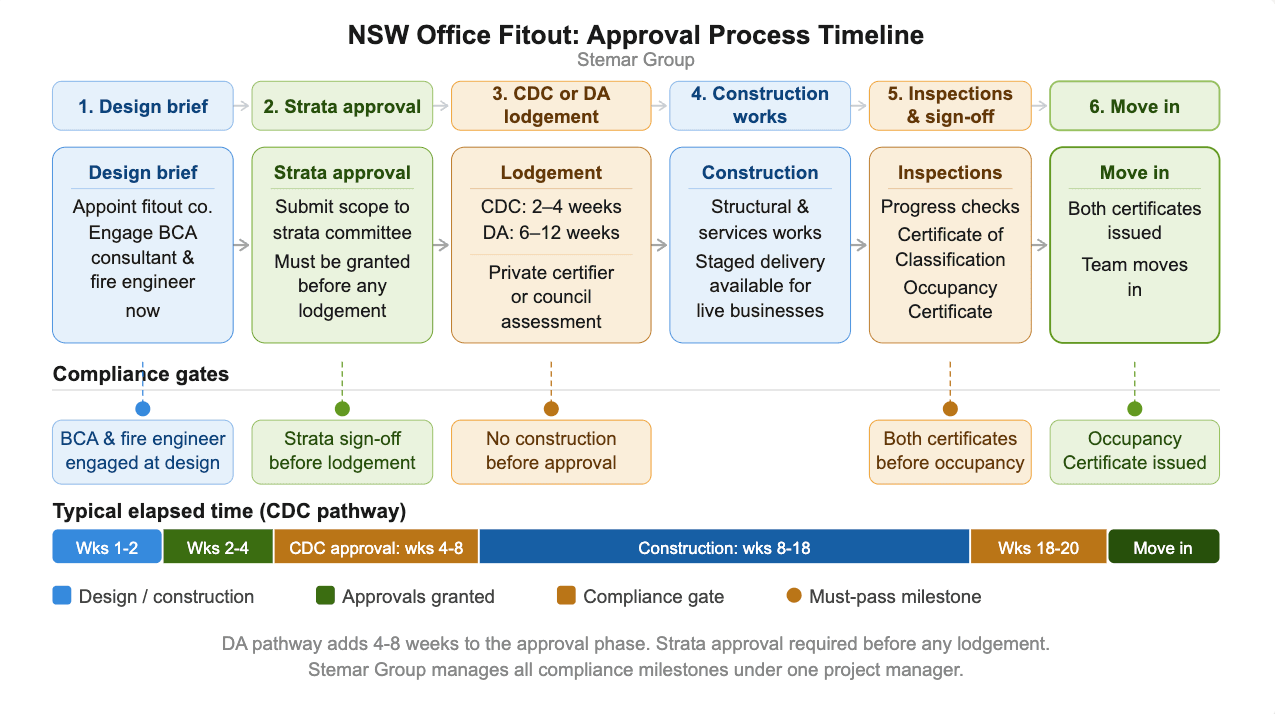
Stemar Group manages every milestone on this timeline under one project manager, so you are never left chasing approvals yourself.
NCC 2026 Changes That Affect Your Office Fitout
The National Construction Code 2026 has introduced updated requirements in three areas that directly affect NCC 2026 office fitout projects: energy efficiency, fire safety, and accessibility.
- Energy efficiency: New lighting and HVAC performance standards for Class 5 buildings mean fitouts involving new mechanical systems or significant lighting changes must meet higher energy targets. This affects design choices around LED specifications, zoning controls, and HVAC sizing. If you are replacing or adding mechanical services, your system design needs to comply with the updated office fitout building code requirements from day one.
- Fire safety: Updated compartmentalisation requirements, egress path standards, and sprinkler specifications apply. If your fitout changes internal layouts, you may trigger new fire safety compliance obligations that did not exist under the previous code. Australian government workplace benchmarks of 12 to 14 square metres per person for standard office fitouts are directly relevant to egress calculations and corridor widths.
- Accessibility: Disability Discrimination Act (DDA) compliance for commercial workspaces has been tightened. Doorway widths, accessible amenities, and circulation space requirements have all been updated.
Stemar Group manages all three of these requirements as part of every office fitout project. You should not need to become an expert in the NCC to get your workspace built. A design process that accounts for compliance upfront prevents costly redesigns once construction starts.
Council-Specific Variations Across Sydney
Different Sydney councils interpret planning controls differently, process applications at different speeds, and require different inspection regimes. This is not theoretical. It directly affects your timeline and cost.
City of Sydney has stricter heritage overlay requirements and longer DA processing times. If your building sits within a heritage conservation area, expect additional documentation and assessment layers, and plan for DA timeframes of 10 to 16 weeks rather than the standard 6 to 12.
Parramatta City Council has been processing higher volumes due to sustained development growth. DA processing times regularly run to 10 to 14 weeks, and the council has specific pre-lodgement consultation requirements for fitouts above a certain project value threshold that can add 2 to 3 weeks before formal lodgement. Factor this into your program early.
Liverpool City Council covers a large area of Western Sydney and applies the Liverpool Local Environmental Plan 2008, which includes specific controls around floor space ratios and land use zones that differ from neighbouring Canterbury-Bankstown and Campbelltown councils. Commercial fitouts triggering a change of use must be assessed against Liverpool's unique zone objectives, which can require additional justification that other councils do not.
Having a fitout company with existing council relationships in your area saves real time. They know the assessment officers, the common objections, and the documentation standards each council expects.
Stemar Group provides office fitout services across Western Sydney with established council relationships in these areas. We deliver commercial fitout projects across Sydney and understand the differences between councils.
When You Need a BCA Consultant and Fire Engineer
A Building Code of Australia (BCA) consultant assesses your fitout design against the NCC and issues compliance reports that certifiers and councils require. Most commercial fitouts that go beyond cosmetic work will need one.
A fire engineer is needed when your fitout changes internal layouts, affects egress paths, modifies fire compartments, or alters sprinkler coverage. Fire engineering reports are often required for CDC applications and always for DA submissions involving fire system changes.
Both specialists should be engaged during design, not after construction drawings are finalised. Late engagement is one of the most common causes of redesigns and delays. They need to review layouts while changes are still easy and inexpensive to make.
Stemar Group coordinates BCA consultants, fire engineers, and certifiers under one project manager. You should not be chasing five separate specialists yourself. Our new office fitout service includes coordination of all compliance specialists so you deal with one team, not five.
Post-completion, your project will require both a Certificate of Classification and an Occupancy Certificate before you can move your team in. Your fitout partner should be managing these milestones as part of the program.
What Compliance Costs to Budget For
These are indicative ranges for a standard office fitout in NSW:
- DA application fees: $2,000 to $10,000+ depending on project value and council
- CDC application fees: $1,500 to $5,000
- BCA consultant fees: $3,000 to $8,000
- Fire engineering reports: $4,000 to $12,000 depending on complexity
- Inspection costs: variable throughout construction
These costs are often missed in early budgeting, leading to mid-project surprises. A fitout company that includes compliance management in their scope gives you a clearer picture from the start with a fixed-price quote that accounts for these line items.
These are not optional extras. They are part of the real cost of fitting out commercial space in NSW. Better to know upfront than discover mid-project.
For the full breakdown of office fitout costs in Sydney, including compliance, design, and construction, see our cost guide.
How to Keep Compliance from Delaying Your Fitout
Most compliance delays come from two causes: late engagement and incomplete documentation. Both are avoidable.
To prevent compliance delays on your NSW office fitout, follow these five steps:
- Engage compliance specialists during design, not after drawings are finalised
- Get strata approval before lodging with council
- Choose the CDC pathway where eligible to save 4 to 8 weeks
- Work with a fitout company that manages approvals as part of their scope
- Submit complete applications the first time to avoid council requests for information
A Stemar Group fitout partner with local council experience knows what each council expects and submits documentation that does not bounce back. Staged delivery and after-hours work options mean construction can progress around your operations once approvals are in hand.
Compliance requirements vary by building class, council, and project scope. Book a free consultation to get project-specific advice from a Stemar Group team that handles this complexity every week.