


If you run a commercial fitout or refurbishment project in NSW, the rules around codes of practice changed on 1 July 2026. Not in a subtle, background-policy way. In a way that directly affects how your site operates, what documentation you carry, and what happens when a SafeWork NSW inspector walks through the door. This guide covers what the NSW codes of practice construction changes mean for PCBUs (Persons Conducting a Business or Undertaking) managing commercial projects, and what you actually need to do about them.
What changed on 1 July 2026, and why your site can't ignore it
Before July 2026, codes of practice in NSW were guidance material. Useful references. Best practice you should follow but technically could set aside without a formal process.
That is no longer the case. From 1 July 2026, PCBUs in NSW must comply with an approved code of practice or demonstrate they have met the same obligation by another means that provides an equivalent or higher standard of protection. Under the comply or justify laws NSW now enforces, introduced by section 26A of the Work Health and Safety Act 2011 (NSW), this is the comply-or-justify framework, and it flips the burden of proof onto you.
If you depart from a code, you must show documented evidence that your alternative meets or exceeds the code’s standard of protection. Not explain it verbally. Not promise to write it up later. Have it documented before the work starts.
The practical consequence is immediate. A SafeWork NSW inspector can issue an improvement or prohibition notice on the spot if you cannot justify a departure. Under the Work Health and Safety Act 2011 (NSW), a code of practice is admissible in court proceedings and may be used as evidence of what is reasonably practicable. That means an undocumented departure is not just a procedural gap. It is direct legal exposure.
This is not a legal footnote. It changes how every commercial site in NSW needs to be run.
Which codes of practice actually apply to commercial fitout and refurbishment
There are over 40 approved codes of practice in NSW as of April 2026, following SafeWork NSW’s multi-year review. You do not need to know all of them. You need to know which ones apply to your project.
For commercial fitout and refurbishment, these are the codes you will deal with most often:
- Construction Work (the foundational code for any commercial build)
- Managing the Risk of Falls at Workplaces (mezzanines, ceiling work, elevated platforms)
- Confined Spaces (ceiling voids, risers, service ducts common in commercial refurbishment)
- Hazardous Manual Tasks (demolition, material handling, repetitive install work)
- Managing Risks of Plant in the Workplace (scissor lifts, hoists, power tools)
- Managing Risks of Respirable Crystalline Silica in the Workplace (February 2026, directly relevant to concrete cutting and engineered stone work in fitouts)
Two new codes from the 2025-2026 review cycle deserve attention. The silica code is critical for any fitout involving concrete cutting, core drilling, or work with engineered stone. The fatigue code (Managing the Risk of Fatigue at Work, February 2026) applies where shift work or extended hours are part of the program.
One important distinction: model codes of practice developed by Safe Work Australia only have legal effect in NSW once formally approved by SafeWork NSW. The national model and the NSW-approved code are not automatically the same document. Always confirm you are working from the NSW-approved version.
What PCBU compliance looks like on a live commercial site
If you are a business owner managing a commercial fitout or refurbishment without a dedicated WHS manager, this is the section that matters most.
PCBU compliance under the comply-or-justify framework is a documentation exercise. The obligation is not just to work safely. It is to prove you are working safely, against specific code requirements, with records that exist before the work starts. For the fitout-specific angle on documentation and approvals, see our guide to office fitout compliance in NSW.
Here is what you need to have ready on site:
- Safe Work Method Statements (SWMS) aligned to applicable codes. Each SWMS must reference the specific code requirements it addresses. A generic SWMS that does not mention the relevant code is not enough under the new framework.
- Risk assessments that reference specific code provisions. If the falls code requires a particular control for work above two metres, your risk assessment must show you have addressed that specific requirement.
- Worker induction records covering code-specific controls. Every worker on site needs to be inducted on the controls that apply to their tasks, with a signed record.
- Variation documentation showing how changes in scope were assessed against applicable codes (covered in detail below).
Here is that same list as a checklist you can take to site and tick off before anyone starts work:
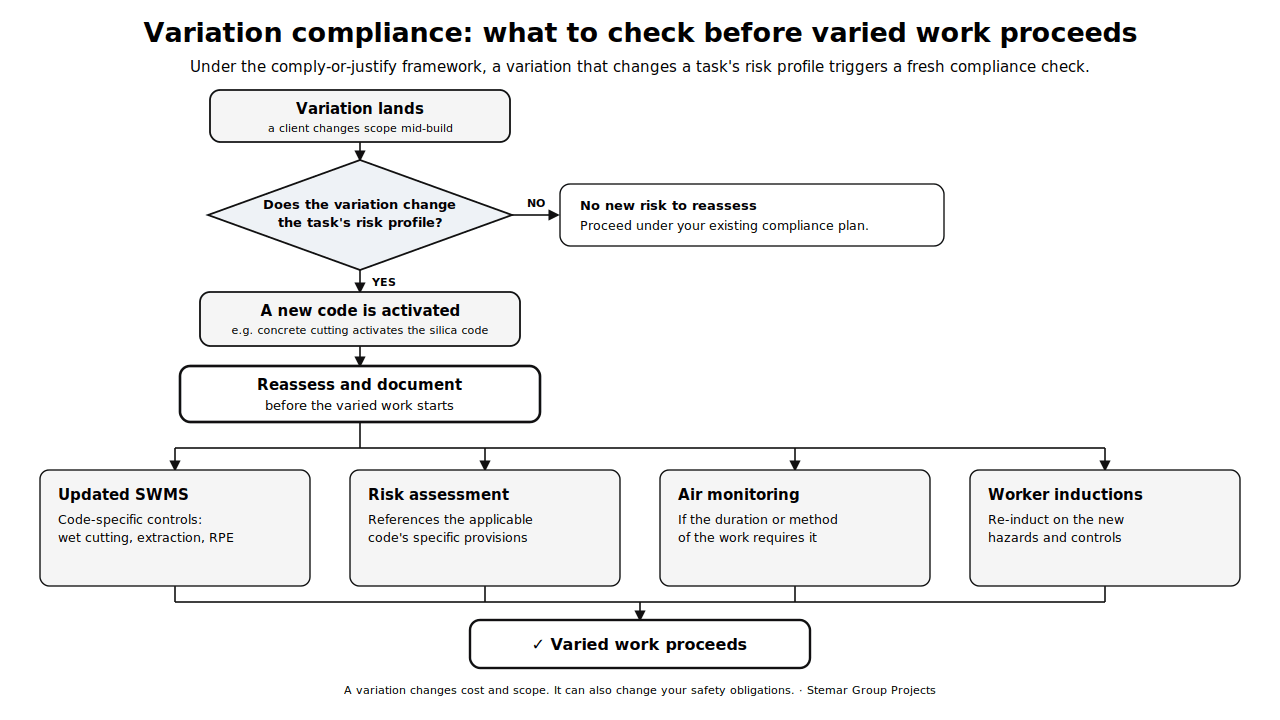
None of this is about how safely the work is done on the day. It is about being able to prove it, which is exactly what an inspector will test.
SafeWork NSW’s 2026-27 stated enforcement priorities include active inspection of code of practice compliance. Inspectors are not just checking for hard hats. They are asking to see your SWMS, checking whether it references the applicable code, and asking how you assessed the risks against that code’s requirements.
The burden of proof sits with the PCBU. If an inspector asks and you cannot produce the documentation, you have a compliance failure. It does not matter how safely the work is actually being done.
How to justify departing from a code
Sometimes you cannot follow a code exactly. Site constraints, building geometry, or access limitations mean the prescribed method will not work. The framework allows for this. But “justify” means something specific.
A valid justification requires three things, all documented before the work commences:
- A written risk assessment identifying the specific code requirement you are departing from and why.
- Evidence that your alternative approach provides an equivalent or higher level of protection than the code prescribes.
- A record of who made the decision, when, and where the documentation is stored.
Verbal justification is not enough. The documentation must exist before the work is done, not after an inspector asks for it.
Here is a worked example. You are installing a mezzanine in a commercial workspace. The falls code specifies edge protection as the primary control. But the building’s existing structure means you cannot fix edge protection to the slab without compromising a heritage facade. Your alternative is a combination of static line systems and harnesses, with rescue procedures documented and tested.
Your justification file includes: the risk assessment noting the specific code clause, structural advice confirming edge protection is not feasible, the alternative control methodology, evidence that the static line system meets the relevant Australian Standard, and sign-off from the site supervisor before work started.
A code of practice is admissible in court proceedings. An undocumented departure is not a minor oversight. It is evidence that can be used against you.
When a variation changes your compliance obligations mid-project
This is where commercial fitout projects get caught out. A variation changes the scope. The scope change introduces a new risk. The new risk activates a code that was not in your original compliance plan.
Under the comply-or-justify framework, a variation that changes the risk profile of a task requires the PCBU to reassess compliance against all applicable codes. Not just the original scope.
Here is a common scenario. Your fitout project originally specified plasterboard partitions. A client variation mid-build changes the design to include a concrete block wall with a service penetration. That concrete cutting activates the new Managing Risks of Respirable Crystalline Silica code (February 2026).
Before that work proceeds, you need:
- An updated SWMS addressing silica-specific controls (wet cutting, extraction, RPE).
- A risk assessment referencing the silica code’s requirements.
- Potentially, air monitoring arrangements depending on the duration and method of cutting.
- Updated worker inductions covering silica-specific hazards and controls.
The full path, from a variation landing to the varied work restarting, looks like this:
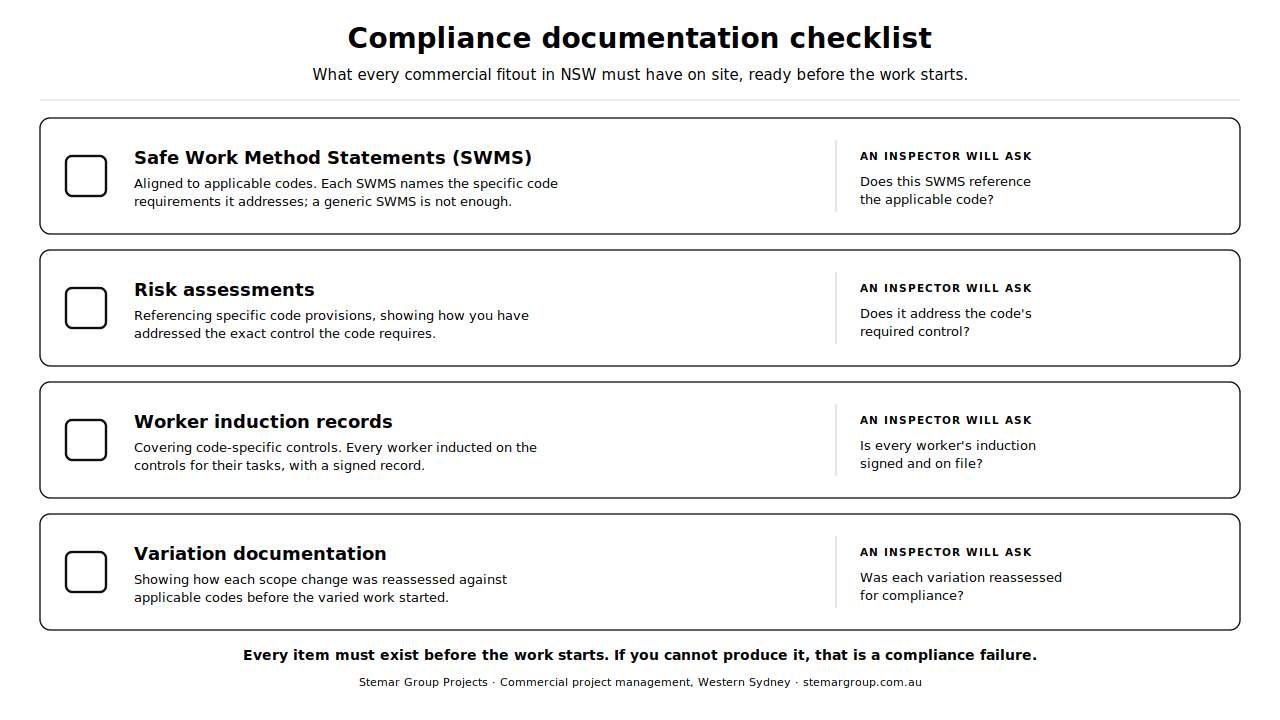
Miss the reassessment step in the middle, and that gap is exactly where your exposure sits.
This is not optional. The NSW construction variation approval process deals with cost and scope. Code of practice compliance deals with safety obligations. Both must be addressed before the varied work starts.
If your variation approval process does not include a compliance reassessment step, you have a gap in your system.
How this fits with NCC 2026
The National Construction Code governs what you build to. Codes of practice govern how you build. Both frameworks changed in 2026, and both apply to every commercial project in NSW.
If you are managing a commercial fitout or refurbishment, you need to be across both simultaneously. The NCC 2026 changes affect design, materials, and performance requirements. The WHS codes of practice changes affect site management, documentation, and worker safety controls.
For the building code side of the story, read our companion guide on NCC 2026 changes for commercial construction.
Read the companion guide: NCC 2026 changes for commercial construction
Why this is a project management problem, not just a safety problem
Everything above is a coordination and documentation challenge. Mapping codes at planning stage. Aligning SWMS before work starts. Reassessing compliance when variations land. Maintaining documentation so it is ready when an inspector walks on site.
This is project management work. And it is not something a PCBU should be solving alone without WHS expertise built into the project delivery.
An experienced commercial project management team handles this as part of the scope. Codes are mapped during planning. SWMS are reviewed against applicable codes before trades mobilise. Variations are assessed for compliance impact before they are approved. Documentation is maintained throughout, not assembled after the fact.
At Stemar, based in Wetherill Park in the heart of Western Sydney’s industrial corridor, we manage multi-trade coordination under one project manager. For more than 20 years we have delivered commercial fitout and refurbishment projects across Western Sydney and NSW, for clients including TAFE NSW, William Angliss Institute, and Clorox Australia, building compliance into project delivery long before it became a legal duty. Our fixed-price quotes include compliance documentation as part of the scope. Not as an add-on. Not as a surprise line item at the end.
Frequently Asked Questions
Are codes of practice mandatory in NSW?
Yes. From 1 July 2026, under the comply-or-justify framework, PCBUs must follow approved codes of practice or document how their alternative approach meets the same standard of protection. They are no longer optional guidance.
What happens if you don't follow a code of practice?
A SafeWork NSW inspector can issue an improvement or prohibition notice on site. The code is also admissible as evidence in court proceedings under the WHS Act 2011 (NSW), meaning non-compliance carries direct legal exposure.
How do I justify departing from a code of practice?
With a documented risk assessment completed before the work starts. The documentation must show your alternative provides equivalent or higher protection than the code prescribes, identify who made the decision, and be available on site for inspection.
Which codes of practice apply to commercial construction in NSW?
The most relevant are the codes for construction work, managing falls, confined spaces, hazardous manual tasks, plant risks, and respirable crystalline silica. NSW has over 40 approved codes in total, but these six cover most commercial fitout and refurbishment work.
Do construction variations affect code of practice compliance?
Yes. If a variation changes the risk profile of a task, you must reassess which codes apply and update your SWMS, risk assessments, and worker inductions before the varied work proceeds. The original compliance plan does not cover new risks introduced by scope changes.
To see how this works in practice on live commercial sites: View recent commercial projects