
NCC 2025 is the latest edition of Australia’s National Construction Code, released by the ABCB on 1 May 2026. It sets minimum standards for building design, construction, and performance. In NSW, it takes effect from 1 May 2027.
If you have been searching for “NCC 2026” or the national construction code 2026, you are not wrong, but the code you are looking for is actually called NCC 2025. The Australian Building Codes Board (ABCB) officially released NCC 2025 on 1 May 2026. People search “NCC 2026” because that is the year the release landed, and the year most of us first heard about it.
The naming follows a three-year review cycle. Previous editions were NCC 2019 and NCC 2022. The number refers to the edition, not the year it takes effect in your state.
That distinction matters in NSW. The code does not apply here just because the ABCB published it. States and territories can adopt NCC 2025 from 1 May 2026, but each jurisdiction sets its own timeline. If you are planning a commercial fitout or refurbishment, the NSW date is the one you need to work to.
The NSW timeline: When NCC 2025 Actually Kicks In
NSW has confirmed a 1 May 2027 commencement date, a 12-month transition from the national release. That gives commercial operators roughly a year to prepare. The NSW Government has confirmed this commencement date.
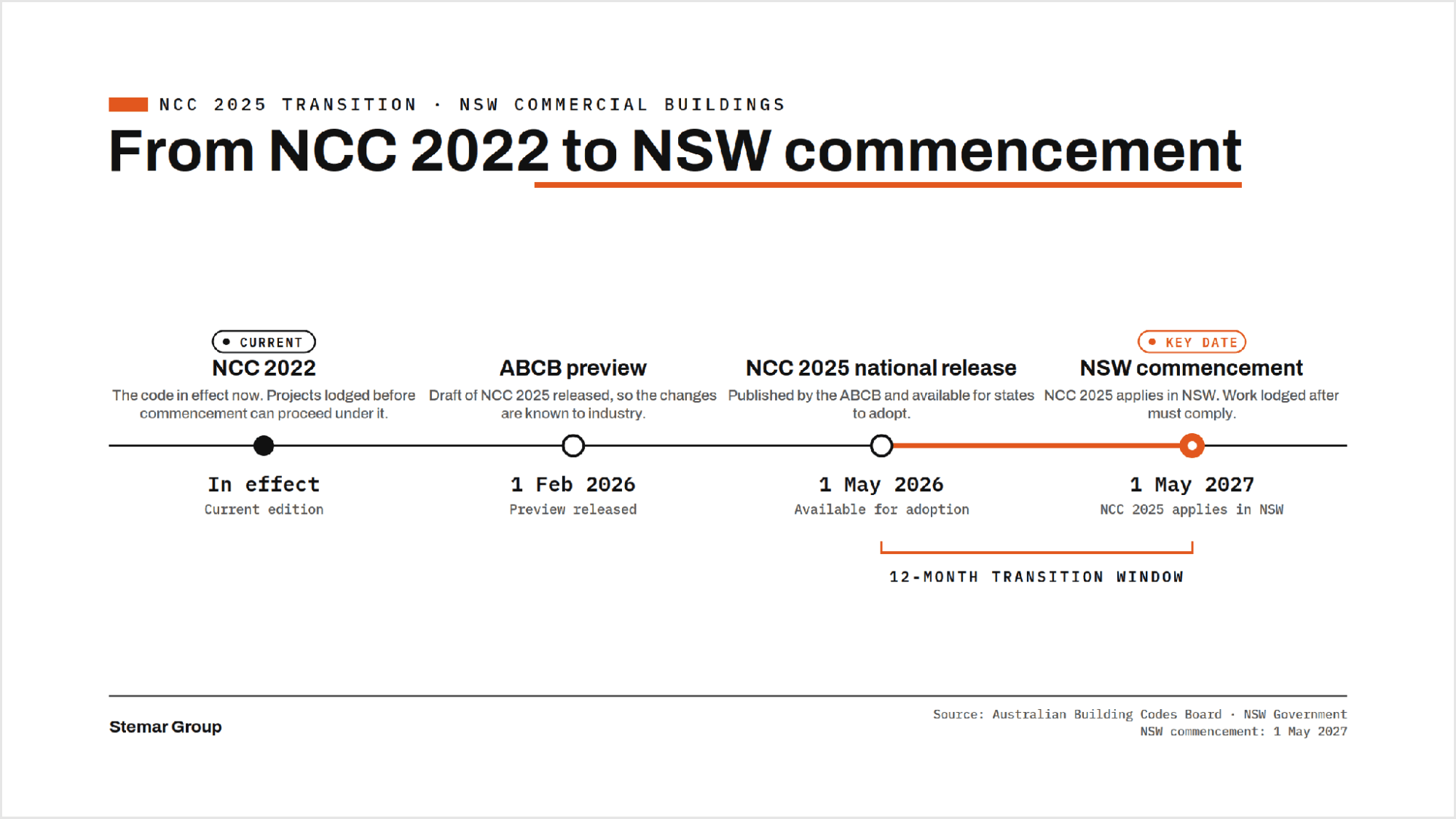
None of these dates should catch a commercial operator off guard. The ABCB released the NCC 2025 preview on 1 February 2026, so the changes have been known to industry since early in the year, and the transition window is generous by code-change standards.
Here is how the transition generally works in NSW. Work lodged before the commencement date can typically proceed under NCC 2022, subject to any NSW variations. Anything lodged after 1 May 2027 will need to meet NCC 2025. In NSW the compliance clock generally runs from lodgement, so confirm the exact trigger for your project with your certifier rather than assuming approval timing locks in the older code.
Either way, the worst position is not knowing the deadline exists. Businesses that understand the timeline can schedule work, lock in pricing, and brief their builder with the right code edition in mind.
What is actually changing for commercial buildings
The NCC 2025 changes for commercial buildings are the most substantial in this edition. The ABCB has been direct about it: this update targets commercial buildings, not residential. Volume 1 of the Building Code of Australia governs commercial buildings, and that is where the heavy lifting sits.
Here is the important nuance for a fitout or refurbishment business. Most of the headline changes apply at the whole-building level and are triggered by new building work or significant base-building change. A routine interior fitout of an existing building usually does not pull them in. The table below shows what each change is and, just as important, whether it is likely to touch a typical tenancy fitout.
| Change area | What it means for your project |
|---|---|
| Energy and solar PV | Whole-building requirement, including on-site solar photovoltaics for certain buildings. Applies to new building work, not to a routine interior fitout. |
| Lighting controls | Automated controls and zoning for commercial energy efficiency. Relevant where your scope includes the base-building electrical design. |
| Carpark fire safety | Updated smoke management and fire separation in commercial and shared carparks. A base-building matter, not typical tenancy fitout scope. |
| Water management | Strengthened provisions targeting water ingress and moisture in the building fabric. Base-building durability rather than interior fitout scope. |
| All-gender facilities | A voluntary, optional pathway. You may provide up to 50 per cent of required amenities as all-gender if you choose to. A design choice, not a requirement. |
| Assessment pathways | Clearer Deemed-to-Satisfy and Performance Solution pathways to reduce ambiguity. Helpful wherever compliance is triggered. |
Does your fitout or refurbishment actually trigger NCC 2025?
This is the question that matters most, and for many projects the honest answer is no. Not every fitout triggers code compliance. As a general principle, cosmetic work like repainting, replacing carpet, or updating furniture does not pull your project into the new code.
Certain thresholds change that. A change of building classification (use), structural alterations, or a significant refurbishment can trigger a development application or construction certificate. Once that happens, the project needs to comply with the edition of the NCC current at the time of lodgement.
So there are broadly three situations:
- Cosmetic-only work: Generally no NCC trigger. Paint, floor coverings, furniture, and like-for-like replacement usually sit outside code compliance.
- Interior fitout or refurbishment that needs approval: The project comes under the current edition at lodgement, but the whole-building provisions (solar PV, base-building energy, carpark, water ingress) typically still do not apply to your interior scope.
- New building work or major base-building change: This is where the headline NCC 2025 provisions can genuinely bite. It is the least common scenario for a standard office refit.
The wider approval picture is set out in this guide to office fitout compliance in NSW. The safest approach is early engagement with a certifier before you commit budget. They can confirm whether your scope triggers compliance at all, and if so, which pathway makes sense. That conversation costs far less than finding out halfway through a build.
All-Gender Facilities: An Option for Your Amenities
Refitting toilets and amenities is core fitout and refurbishment work, so this is the NCC 2025 change most likely to be relevant to a Stemar-style project, and it is good news because it adds flexibility rather than cost.
NCC 2025 introduces all-gender facilities as a voluntary Deemed-to-Satisfy pathway, not a mandatory requirement. You may provide up to 50 per cent of the required male and female facilities as all-gender facilities if you choose to, applied equally, with more flexibility where occupancy is low.
For a refurbishment, that can mean better use of a tight floor plate, fewer separate rooms to build, and an amenities layout that suits how your team actually works. It is worth weighing at the design stage. But to be clear, it is a choice, not an obligation, and a fitout that keeps conventional separate facilities remains fully compliant.
The other provisions, and why they usually will not apply to your fitout
Energy efficiency and solar PV are the headline additions in NCC 2025. NCC 2025 introduces on-site solar photovoltaic requirements and tighter energy provisions for certain commercial buildings, applied at the whole-building level. For most tenant fitouts this will not apply, because the requirement attaches to the building or development, not to an interior refit. It becomes relevant only when your scope includes new building work or significant base-building change. The ABCB has published calculators and worked examples, and a certifier can confirm quickly whether your specific project is caught.
Carpark fire safety and water management sit in the same category. Carpark provisions cover smoke management and fire separation in commercial and shared carparks. Water management provisions target water ingress and moisture in the building fabric, so weatherproofing rather than interior plumbing. Both are base-building matters that a standard interior fitout does not reach. Note that the proposed EV charging provisions were not included in NCC 2025, so the carpark update is a general fire-safety change rather than an EV-specific one.
The practical point is scope confirmation, not assuming the worst. If your project does trigger these provisions, they belong in the scope and the quote from day one rather than bolted on later. If it does not, you should not be paying for provisions that do not apply to your fitout. Either way, a fixed-price quote should state clearly which NCC 2025 provisions are in scope and which are not.
How to plan your project around the transition window
How to prepare for NCC 2025 in NSW: if you are planning a commercial fitout or refurbishment in the next 12 to 18 months, follow this sequence.
- Confirm whether your scope triggers compliance at all: Check with a certifier whether your work needs a construction certificate and which code edition applies. For cosmetic work, this may be the only step you need.
- Get a fixed-price quote that names which NCC 2025 provisions are in scope: A good quote should say plainly what applies and what does not. If it is silent on this, ask.
- Lock in your lodgement timing relative to 1 May 2027: To proceed under NCC 2022, your application needs to be lodged in time, subject to NSW variations. If you are planning for NCC 2025, brief every trade to the new requirements.
- Allow procurement lead time for anything genuinely triggered: Where a provision does apply, long-lead items can stretch a programme, so build buffer into the schedule from the start.
- Engage a project team that tracks code changes so you do not have to: Multi-trade coordination, council approvals, and staged delivery all get more complex during a code transition. A team experienced in commercial fitouts and refurbishments across Western Sydney can keep your project on the right side of compliance without you needing to read the code yourself.
NCC 2025 is only half the compliance picture in NSW
The National Construction Code covers building standards: how a building is designed, constructed, and performs. But it does not cover workplace safety obligations on construction sites. Those sit under state WHS legislation and the associated Codes of Practice, which matter on any occupied site where your business keeps running during the works.
Both frameworks are updating across 2026 and 2027. A compliant project in NSW needs to satisfy both the NCC and the relevant state workplace safety codes. Getting one right and missing the other still leaves you exposed.
Frequently asked questions about NCC 2025 in NSW
When does NCC 2025 apply in NSW?
NSW adopts NCC 2025 on 1 May 2027, a 12-month transition from the national release. Work lodged before the commencement date can generally proceed under NCC 2022, subject to NSW variations. Because the NSW clock generally runs from lodgement, confirm the exact trigger for your project with your certifier.
Is it called NCC 2025 or NCC 2026?
The official edition is NCC 2025. It was released by the ABCB on 1 May 2026. People search “NCC 2026” because that is the year it was published, and the year most people first encountered it. The number refers to the edition, not the enforcement year.
Does a commercial fitout trigger NCC 2025 compliance?
Often it does not. Cosmetic work like painting or new flooring generally does not trigger compliance. A change of use, structural alterations, or a significant refurbishment can require a construction certificate, which brings the project under the current code edition. A certifier can confirm your obligations early in planning.
Do the solar PV and energy changes apply to my office fitout?
Usually not. Solar PV and energy efficiency provisions apply at the whole-building level and are triggered by new building work or major base-building change, not by a routine interior fitout. Ask your certifier whether your specific scope is caught.
How much will NCC 2025 compliance add to my project cost?
For most tenancy fitouts, little or nothing, because the major new provisions apply at building level. Where a project does trigger compliance, the impact depends on scope. The best way to understand it is a fixed-price quote that states clearly which NCC 2025 provisions are in scope and which are not.