
Choosing the right glass partitions for office spaces in Sydney starts with your business situation, not a supplier’s catalogue. Stemar Group works with businesses across Greater Sydney every week, and the same five factors drive every partition decision before a single product spec is reviewed:
- Use case: client-facing or operational
- Lease length and flexibility: short-term, break clauses, make-good obligations
- Acoustic privacy requirements: the dominant concern in 2026 as businesses deal with open-plan noise post-return-to-office
- Headcount stability: growing, shrinking, or uncertain
- Budget envelope: capital expenditure vs long-term flexibility
Most businesses walking into this decision right now are dealing with the same thing: teams are back in open-plan offices and the noise is a problem. That is the return-to-office reality driving partition conversations across Sydney.
This post is a decision framework. Each section maps a partition type to the scenario it solves best. Read the section that matches your situation, skip the ones that don’t.
Partition Types at a Glance
The table below maps all five partition types by use case, acoustic performance, flexibility, install speed, and lease suitability. Use it to find your starting point before reading the relevant section below.
| Partition type | Best for | Acoustic rating | Relocatable | Install speed | Lease suitability |
|---|---|---|---|---|---|
| Glass (single glazed) | Aesthetics, natural light, client-facing spaces | Low (Rw 20-28) | No | Moderate | Long-term |
| Acoustic stud wall | Sound separation, NCC compliance, post-RTO noise | High (Rw 45-65+) | No | Slower | Long-term |
| Demountable | Flexibility, shorter leases, relocation | Moderate (Rw 32-45) | Yes | Fast | Short-term (3-5 yrs) |
| Modular with door | Speed, consistency, multi-site fitouts | Moderate (Rw 32-45) | Partial | Fastest | Medium-term |
| Full-height walls | Fire rating, permanent rooms, max acoustic | Very high (Rw 50+) | No | Slowest | Long-term |
Glass Partitions: When First Impressions and Natural Light Matter Most
Client-facing businesses, professional services firms, reception areas, and workspaces where natural light penetration is a design priority.
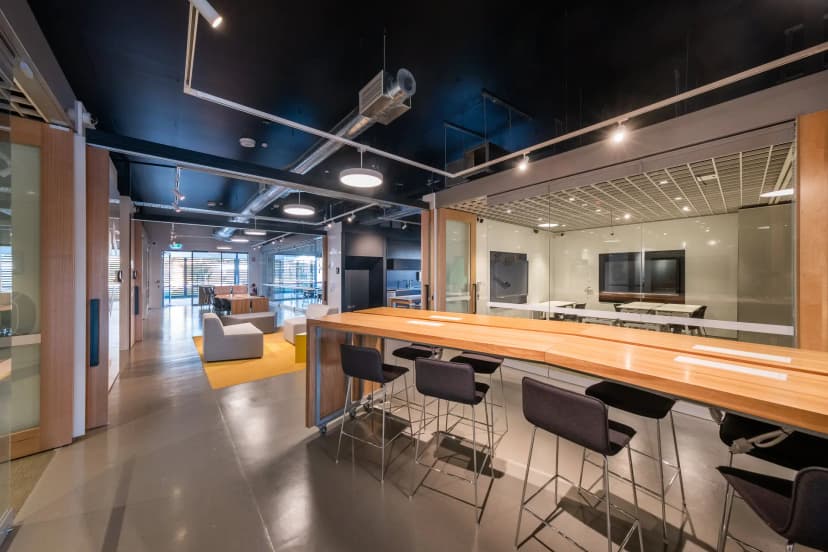
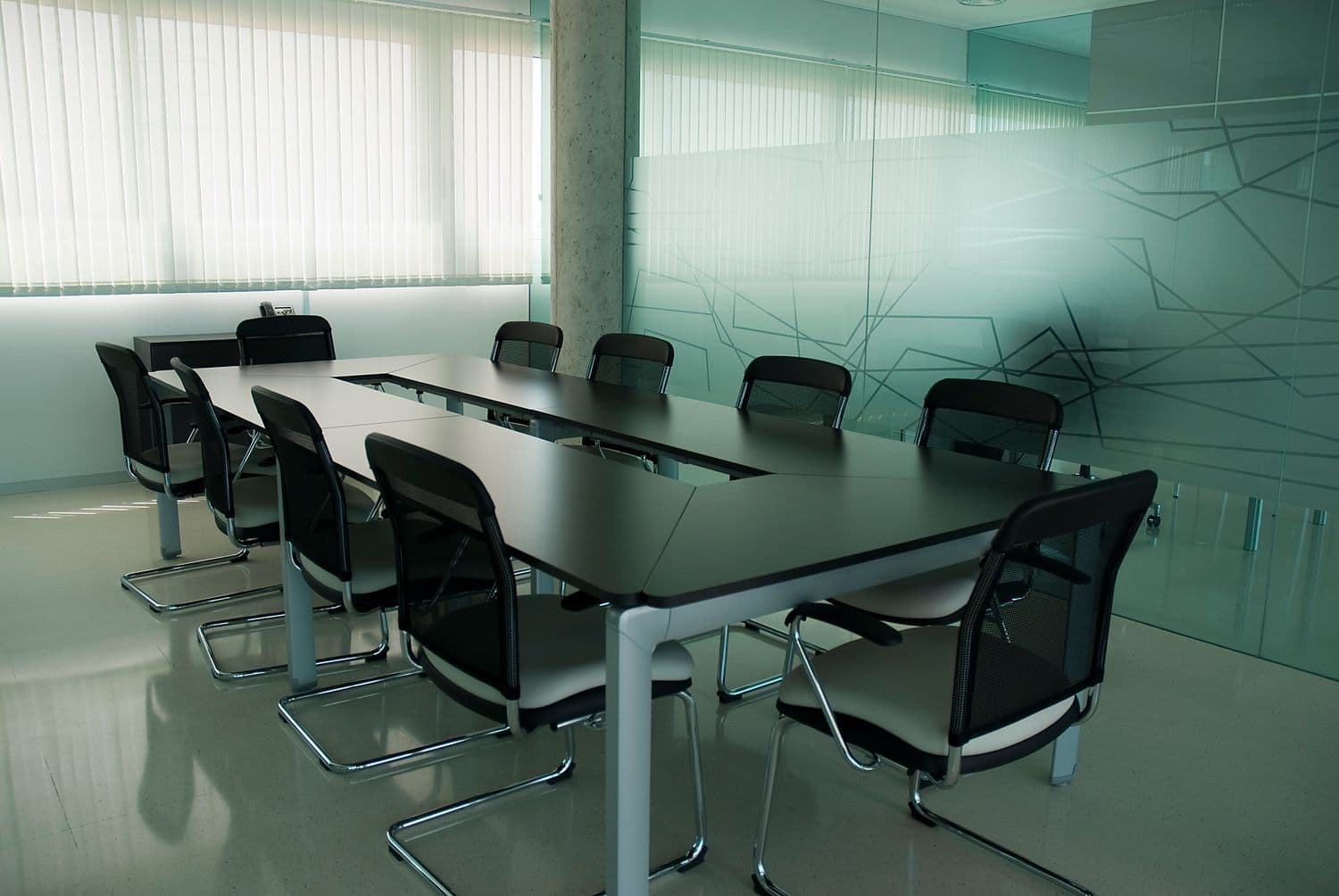
You need to project professionalism and want visual openness without sacrificing defined zones. Research shows that access to natural light improves employee wellbeing scores by up to 15% and reduces reliance on artificial lighting by 20 to 30%. A glass partition for office environments works when the goal is sightlines and aesthetics, not sound isolation.
If sound is your primary concern, skip to the acoustic section below. Single-glazed glass typically achieves an Rw rating of 20 to 28, which falls below NCC 2022 Section F7 minimum requirements for most commercial office configurations.
Acoustic privacy is your primary concern. If your workspace is industrial or operational and aesthetics are secondary, glass is likely the wrong starting point.
A professional services firm in the CBD or Parramatta creating meeting rooms without blocking sightlines across the floor plate. Stemar Group handles AS 1288 compliance and manifestation requirements as part of every glass partition scope.
Any glass partition installed in NSW must comply with AS 1288, which governs glass selection and installation. NCC 2022 energy efficiency provisions also apply for Sydney buildings in climate zone 5.
See how Stemar Group scopes and installs glass office partitions for Sydney commercial spaces. For a full breakdown of glazing types and framing options, read the ultimate guide to glass office partitions for Sydney businesses.
Acoustic Partitions: the RTO privacy problem most offices haven’t solved yet
Teams came back to open-plan offices and immediately hit the same problems: noise complaints, confidentiality issues in meetings, and measurable productivity loss. Research from Cornell University found that open-plan office noise reduces cognitive performance on complex tasks by up to 66%. Acoustic privacy is the dominant office design concern heading into 2026, and Stemar Group is delivering more acoustic partition scopes now than at any point in the past three years.
- Who it’s for: Any business dealing with open-plan noise post-RTO. Organisations with confidentiality requirements in legal, medical, or financial settings. Workspaces where phone calls and video meetings are constant.
- When to choose it: Acoustic privacy is the primary driver. You need to meet NCC 2022 Section F7 sound insulation requirements. You are retrofitting an existing open-plan space rather than building from scratch.
- When to avoid it: Your space is already enclosed and the issue is aesthetics or flexibility, not noise. Glass or demountable partitions are a better fit in those cases.
Rw rating (weighted sound reduction index): The metric that measures how much sound a partition blocks, measured in decibels. Required under NCC 2022 Section F7 for commercial office partitions in Australia. A meeting room adjacent to open plan typically requires a minimum Rw 40. A medical consulting room may require Rw 50 or above. If your contractor cannot state the Rw rating of what they are quoting, you are guessing.
Sound leaks through gaps, not panels. A partition with a strong Rw rating underperforms if there are gaps at ceiling junctions, around door frames, or where services penetrate the wall. Stemar Group coordinates acoustic partitions across all trades under one project manager, preventing the service penetrations that compromise the final Rw rating in practice.
A growing business in Western Sydney that went open-plan five years ago and now needs meeting rooms and focus zones that actually block sound. Every phone call is everyone’s phone call.
Start with Stemar Group’s acoustic office partitions page for Sydney Rw specifications. For a deeper technical guide, see the complete guide to acoustic office partitions in Sydney.
Demountable Partitions: Built to Move When Your Business Does
Businesses on shorter leases of three to five years. Companies with uncertain headcount growth. Tenants who want to take their partitions when they relocate.
Your lease has a break clause or renewal uncertainty. Demountable means engineered for disassembly, transport, and reinstallation, with typical reinstallation costs at 25 to 35% of original supply. Not temporary screens. A partition system built to move when your business does.
You need permanent, high-acoustic-rated separation or fire-rated walls. Demountable partitions are not the right product for those applications.
Sydney commercial leases increasingly include make-good clauses requiring you to return the space to its original condition. That obligation can run to $20,000 to $80,000 depending on the scope of fixed work. Demountable partitions can be removed cleanly, significantly reducing end-of-lease exposure.
A logistics business in the Smithfield-Wetherill Park Industrial Estate growing fast with two years left on the lease. Stemar Group installs partitions that can be relocated when the business moves, turning a potential make-good liability into a reusable asset.
Explore Stemar Group’s demountable office partitions for Sydney commercial lease applications.
Modular Partitions: Pre-Engineered Systems for Speed and Consistency
Businesses that need a fast install with minimal disruption. Multi-site operators wanting a consistent look across locations.
You need partitions installed quickly. Pre-engineered components reduce on-site time by 40 to 60% compared to traditional stud wall construction, and the system integrates doors, glazing, and solid panels in a single framework.
You need maximum relocation flexibility, in which case demountable is the better choice. Your space has unusual dimensions that do not suit standardised panel sizes.
A company fitting out a new Parramatta office wanting partitions installed over a weekend to avoid disrupting the team. Stemar Group coordinates electrical, data, and HVAC integration within the same install window, eliminating the trade-to-trade handoffs that blow out timelines.
See how Stemar Group’s modular office partition systems reduce install time for Sydney commercial fitouts. For a breakdown of advantages, read 7 benefits of modular office partitions.
When You Actually Need Walls, Not Partitions
Fire rating requirements under the NCC mandate full-height construction in certain commercial applications. Full floor-to-ceiling sound isolation is needed. You are creating permanent rooms, not flexible zones. The NSW WHS Act 2011 also adds notification and safety planning obligations when structural wall work is undertaken in a live operational environment.
If full-height separation is what you need, our office partition walls page covers the options for Sydney commercial spaces. For an overview of compliance requirements, see the full office fitout compliance guide for NSW.
Five Questions to Ask Before You Choose a Partition Type
The flowchart below maps your primary problem to the right partition type, use it as a quick reference, then read the relevant question below for the detail behind the recommendation.
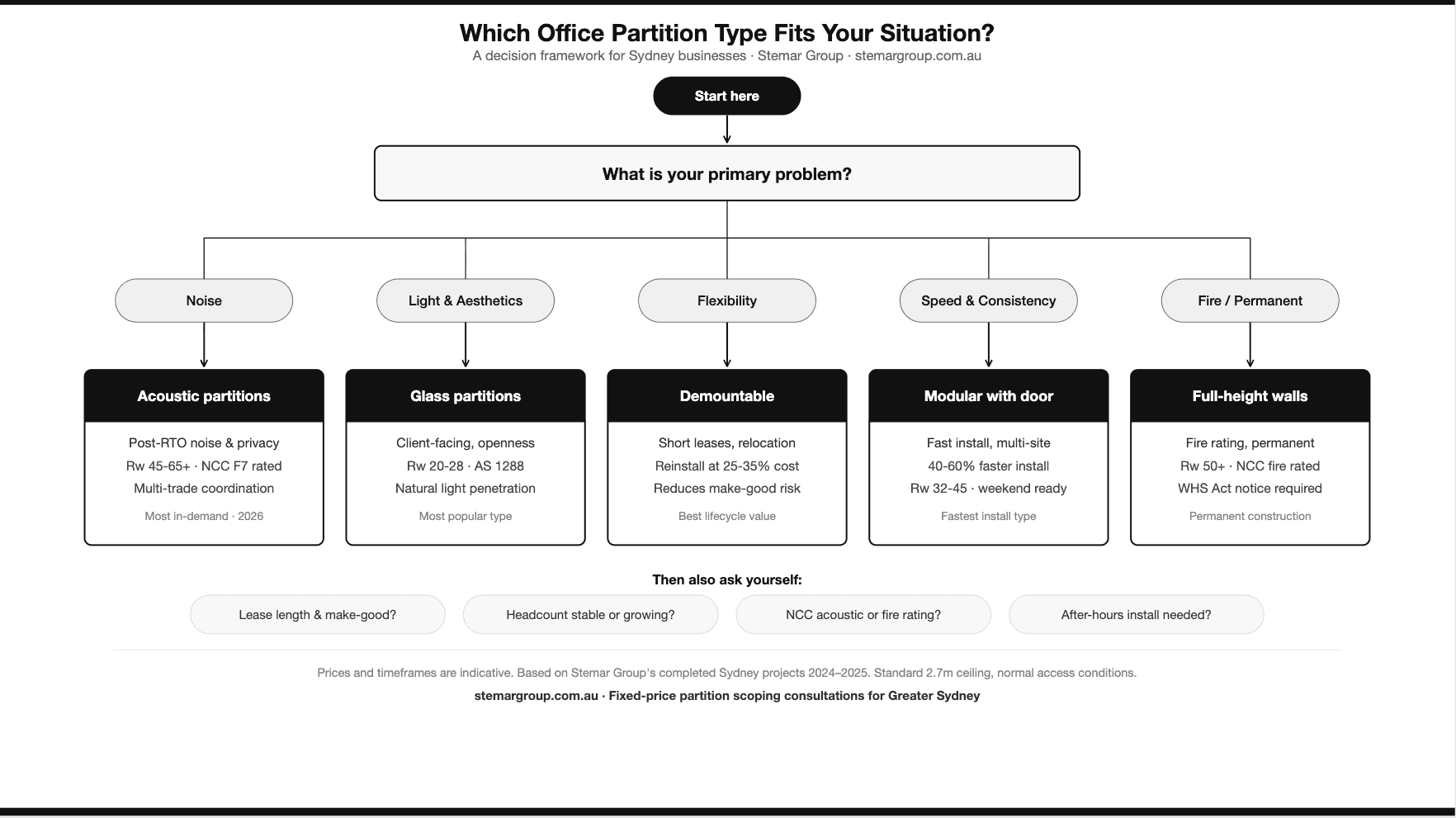
The five questions below expand each branch in the flowchart, so you can confirm the right choice before you get in touch with Stemar Group.
- What is the primary problem you are solving?
Noise points to acoustic partitions. Aesthetics and light point to glass. Flexibility points to demountable. Speed points to modular.
- How long is your lease and does it have a make-good clause?
A short lease or make-good exposure favours demountable. Long-term tenure opens up all options.
- Is your headcount stable or changing in the next two to three years?
Uncertain growth favours demountable or modular systems that can adapt without demolition costs.
- Do you need to meet NCC acoustic or fire rating requirements?
If yes, you need partitions specified to Rw ratings or fire-rated walls. Not all partition types qualify.
- Can your business absorb a multi-day install or do you need after-hours or staged delivery?
Modular systems with pre-engineered components and after-hours install are the fastest path when disruption is a concern.
If you answered more than one of those questions with uncertainty, a scoping conversation locks the scope and the price before work begins. Stemar Group handles local council approval where it is part of your situation.
Related Decision Guides from Stemar Group
This post is part of Stemar Group’s consultative decision guide series for Sydney business owners. If you are earlier in the decision process:
- Commercial fitout and refurbishment: what’s the difference covers the scope question that often comes before partition selection
- Open plan office vs partitioned compares the two layout approaches before you commit to a partition strategy
- Office renovation Sydney helps you determine whether renovation or targeted refurbishment is the right approach
Not Sure Which Partition Type Fits Your Space?
Book a partition scoping consultation with Stemar Group. We will walk through your space, your lease, and your priorities and recommend the right partition type before we talk price.
Stemar Group is based in Wetherill Park and services projects across Greater Sydney. You get direct owner contact and a fixed-price quote with no hidden surprises. Contact Stemar Group.
Frequently Asked Questions About Office Partitions in Sydney
What is the difference between acoustic partitions and standard glass partitions for offices?
A standard glass partition for office use is designed for visual separation and light transmission, typically achieving an Rw rating of 20 to 28. An acoustic partition is specified to block sound to a measurable Rw rating, with NCC 2022 Section F7 setting minimums based on room function. Single-glazed glass will not solve open-plan noise. Specify by Rw rating, not by marketing claims about acoustic performance.
How long does it take to install a modular partition for an office in Sydney?
Modular partition systems arrive pre-engineered, reducing on-site time by 40 to 60% compared to traditional stud wall construction. A typical office floor plate can be partitioned over a weekend with after-hours installation. The exact timeline depends on the size of the space and the complexity of services integration, including electrical, data, and HVAC.
Do partition walls for offices need to meet NCC compliance in NSW?
Yes. Partition walls for office applications in NSW must comply with NCC 2022, including acoustic requirements under Section F7 and fire rating requirements where applicable. Glass partitions must also comply with AS 1288 for glass selection and installation. Compliance should be confirmed during specification, not after installation.