


If you run a growing industrial or commercial business in Sydney with a project somewhere between $250K and $2M, you already know the problem. The large firms treat you as a small job. You get deprioritised, delayed, and handed off to junior staff. The sole operators promise the world but lack the systems, licensing, or capacity to deliver when it counts.
You are probably frustrated. Maybe cautiously optimistic because you have found a shortlist of project managers who look like they can actually handle your scope. And now you are researching project management fees construction companies charge, because you are getting closer to pulling the trigger.
Here is what matters most: the fee model you choose matters more than the percentage itself. It determines whether your PM has any financial incentive to keep your costs down and your doors open. That is what this guide is about, written from Wetherill Park in the heart of Sydney’s industrial heartland.
Three Common Project Management Fee Models
There are three fee structures you will encounter when comparing construction project management fees in Australia. Each one shifts risk differently between you and the Project Management.
The comparison below sums up how the three models stack up on the dimensions that matter most, before we break each one down.
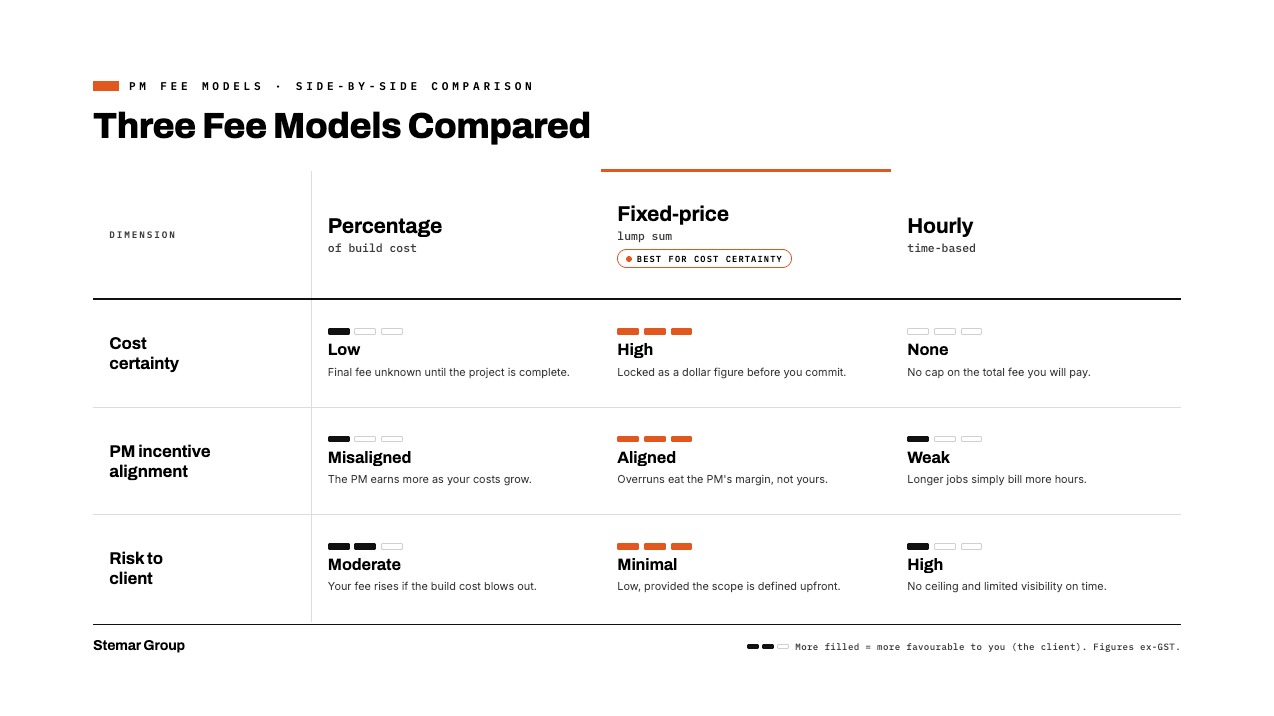
Here is what each model means in practice, starting with the most common.
Percentage of Build Cost
This is the most common model. The project manager cost is calculated as a percentage of your total construction spend. For commercial work in Australia, industry benchmarks put that between 4% and 8% of total project cost, depending on scope complexity. Smaller projects attract higher percentages because the coordination effort does not scale linearly with project value.
- What you pay: A proportion of your final build cost, calculated at completion or at agreed milestones.
- When you pay: Progressively, usually aligned with builder payment claims.
- What risk you carry: If costs blow out, your PM fee blows out with them.
Fixed-Price Lump Sum
The PM provides a fixed-price quote for a defined scope of work. You know the fee before you commit, and it does not change unless you change the scope.
- What you pay: A locked dollar amount agreed upfront.
- When you pay: Staged payments tied to project milestones.
- What risk you carry: Minimal, provided the scope is clearly defined at the start.
Hourly or Time-Based
The PM charges by the hour or day. Common for advisory-only roles or very early-stage feasibility work, but risky for full project delivery.
- What you pay: An hourly or daily rate, often with a rough estimate but no cap.
- When you pay: Monthly invoices based on timesheets.
- What risk you carry: Significant. There is no ceiling on the total fee, and you have limited visibility on how time is being spent.
One important note across all three models: GST at 10% applies to PM fees in Australia and must be disclosed separately in any fee proposal under Australian Consumer Law. Always confirm whether a quoted figure is ex-GST or inclusive.
Understanding how to calculate project management fees starts with understanding which model is being used. The project management fee percentage construction firms quote means nothing in isolation. You need to know what is included, what is excluded, and where the incentives sit.
Whatever the model, a full engagement should cover a baseline set of services. Confirm a proposal includes at least:
- Tender management, including preparing scope, inviting trades, and levelling quotes
- Contract administration, covering the builder contract, payment claims, and variations
- Programme and progress reporting, with a live schedule and regular updates to you
- Site coordination, sequencing trades and managing access, safety, and council requirements
- Defect management, running the defects list through to final sign-off
Where Hidden Costs Creep In and Why Percentage Fees Create a Conflict of Interest
Here is the problem with percentage-based fees that nobody talks about: under a percentage model, the more your project costs, the more the PM earns. There is zero financial incentive for the PM to find savings. In fact, every variation, every delay, every provisional sum that blows out puts more money in their pocket.
The common hidden cost traps include:
- Variations not flagged early, leaving you to absorb cost increases after the fact
- Scope creep without a formal change order process, so the project grows without your explicit approval
- Provisional sums that are set low to win the job, then blow out during construction
- Admin, coordination, or site attendance charges billed on top of the percentage fee
- PM fees that exclude critical stages like council liaison or defect rectification
A fixed-price PM engagement removes this conflict entirely. The PM’s fee is locked at the start. If the project drags or costs escalate due to poor coordination, that eats into the PM’s own margin, not yours. The incentive flips: your PM is now motivated to deliver on time and on budget.
This is exactly how fixed-price design and construct engagements work in practice. The scope is defined upfront, the fee is locked, and the PM carries the risk of their own efficiency.
One honest caveat: fixed-price models require a clearly defined scope of works before the fee is set. Scope creep without a change order process is the primary cause of disputes under fixed-price contracts. A good PM addresses this by investing time upfront to define scope thoroughly and by running a transparent change order process throughout the project.
Want to see how fixed-price PM works on a commercial fitout? Talk to our team.
Indicative PM Fee Ranges for Sydney Commercial Projects
The following ranges are indicative market rates for building project management fees on commercial fitout and industrial refurbishment projects in Sydney. These are not quotes. Actual fees depend on scope complexity, staging requirements, and project duration. All figures are ex-GST.
The following table shows indicative PM fee ranges for Sydney commercial projects (ex-GST).
| Project size (AUD) | Percentage-based fee range | Fixed-price fee range (indicative) |
|---|---|---|
| $250K to $500K | 6% to 8% ($15K to $40K) | $18K to $35K |
| $500K to $2M | 4% to 6% ($20K to $120K) | $25K to $90K |
A few things to note when comparing these ranges.
Smaller projects attract higher percentages because the PM still needs to coordinate multiple trades, manage council requirements, and run the same reporting processes regardless of project value. The effort does not halve just because the dollar value does.
Fixed-price ranges tend to be tighter because the PM has already scoped the work and priced their effort. You get cost certainty. Under a percentage model, your final PM fee is unknown until the project is complete.
PM Fees are an Investment in Preventing Operational Disruption
For a business that needs to stay open during works, the PM fee is not a line item to minimise. It is the cost of keeping your operations running while construction happens around you.
A capable PM manages staged delivery so your workspace remains functional throughout the build. They coordinate after-hours work to keep noisy or disruptive trades away from your operating hours. They sequence multiple trades under one project manager so you have a single point of accountability, not five subcontractors calling you with questions.
As the hidden costs section above explains, a percentage fee gives the PM no reason to compress timelines, while a fixed-price engagement puts that urgency back on them.
If your project involves commercial fitout project management where the business cannot shut down, this distinction is critical. The fee model you choose determines whether your PM shares your urgency or simply bills through it.
See how our fixed-price design and construct model works for Sydney commercial projects.
How to evaluate a project manager before you compare fees
Comparing fees without evaluating the PM behind them is like choosing a builder based on the lowest quote without checking their licence. Here are five criteria to assess before you look at a single dollar figure. For the full delivery picture, our guide to the building project management process walks through each stage.
- Does the PM hold appropriate licensing and qualifications for your work? Licensing requirements in NSW differ between residential and commercial building work, so ask what licences or qualifications the PM holds, and whether the trades they engage are appropriately licensed for your project. This separates qualified operators from those who cannot properly stand behind the work.
- Do they offer a fixed-price quote with a clearly defined scope? If the scope is vague, the fee is meaningless. Ask to see what is included and what triggers a variation.
- Can they show local commercial project experience? A PM who has delivered industrial refurbishments and commercial fitouts in Western Sydney understands local council requirements, trade availability, and site access constraints that a generalist will not.
- Will you deal directly with the project manager or be handed off? On mid-market projects, you should have direct contact with the person managing your build. If the person you meet during the sales process disappears after you sign, that is a red flag.
- Do they have a clear change order process? This is the single most important safeguard against disputes on any PM engagement, whether percentage-based or fixed-price. Ask how changes are documented, approved, and priced.
The lowest fee is not the best fee. The best fee is the one attached to a PM who will protect your total project cost and keep your business running.
Get a Fixed-Price PM Quote for Your Sydney Project
If you have read this far, you are not looking for the lowest number. You are looking for cost certainty and a PM who has a reason to deliver on time.
We offer fixed-price quotes with no hidden surprises across three service areas: commercial project management in Sydney, commercial fitout PM, and design and construct. Based in Wetherill Park, we work with industrial and commercial businesses across Greater Western Sydney and beyond.
If you want to know exactly what your PM will cost before you commit, talk to us.
Get a fixed-price quote for your project. Book a free site assessment with our team in Western Sydney.
Frequently Asked Questions
How do you calculate project management fees for construction?
PM fees are calculated using one of three models: a percentage of total build cost (typically 4% to 8% for commercial work in Australia), a fixed-price lump sum based on a defined scope, or an hourly rate. The right model depends on your project size, complexity, and how much cost certainty you need. All fees are subject to GST at 10%.
What is a typical project management fee percentage for construction in Australia?
For commercial construction in Australia, PM fees typically range from 3% to 8% of total project cost. Smaller projects attract higher percentages because coordination effort does not scale linearly with project value. A $300K fitout might attract a 7% fee, while a $1.5M refurbishment might sit closer to 4%.
Do project management fees include GST?
GST at 10% applies to all project management fees in Australia. PM firms are required to disclose GST separately in fee proposals. Always confirm whether a quoted fee is ex-GST or GST-inclusive before comparing proposals.
What is a fair project management fee for a commercial fitout?
For a commercial fitout in Sydney in the $250K to $2M range, expect PM fees between 4% and 8% under a percentage model, or a fixed-price fee between $18K and $90K depending on scope complexity. A fair fee is one that includes a clearly defined scope, a transparent change order process, and is quoted by a PM with relevant commercial project experience and appropriate NSW licensing.
Is a percentage or fixed-price PM fee better for commercial construction?
For most commercial fitout and refurbishment projects, a fixed-price fee offers better protection because it locks your cost upfront and removes any incentive for the PM to let the budget grow. A percentage fee can suit early feasibility work or genuinely open-ended scopes, but your final fee stays unknown until completion and rises with every variation.