
Based on Stemar Group’s 20+ years of commercial fitout delivery across Greater Sydney.
Portable office partitions and portable office pods are surging in Australian search data. The term "portable office partitions" has hit breakout status on Google Trends, signalling sharp commercial demand beyond passing curiosity. The broader keyword cluster now has 470 monthly searches with low competition, indicating an emerging category that existing content has barely touched.
This is not a residential trend. The businesses driving these searches are operations managers, facility leads, and business owners questioning whether permanent fitout still makes sense. Leases are getting shorter. Teams are shifting shape. And the old model of building plasterboard walls you will demolish in five years is starting to look like a poor use of capital.
The commercial heart of the demand sits in growing corridors like Western Sydney, where businesses are scaling fast and need workspace that keeps pace. Stemar Group works with businesses across Western Sydney’s industrial corridor every week.
Three Business Drivers Behind the Shift to Portable and Demountable Systems
Three structural forces are pushing commercial tenants toward demountable partition systems and away from traditional permanent construction.
- Lease flexibility: Five-year commercial leases are now standard across much of Sydney, and shorter terms are common in fast-growing industrial corridors. Traditional plasterboard stud walls are designed for a 10-year asset life. That mismatch creates a painful choice at lease end: pay $20,000 to $80,000 for a full strip-out to meet make-good obligations, or walk away from a fitout you cannot take with you. Demountable wall partitions sidestep both outcomes.
- Headcount uncertainty: The team that moves in on day one rarely matches the team working there 18 months later. RTO mandates, hybrid sizing, restructures, and growth spurts all change the numbers. Research from JLL found that 68% of Australian businesses restructured their office layout at least once in the past three years. Fixed walls lock in a layout that stops working the moment headcount shifts. A moveable partition wall for office use lets you reconfigure without demolishing anything.
- ESG and sustainability obligations: Every strip-and-skip demolition cycle sends plasterboard, steel framing, and insulation to landfill. For businesses on government-adjacent contracts in NSW, ESG reporting requirements are tightening. Reusable partition systems avoid demolition waste, reduce embodied carbon by up to 60% across multiple fitout cycles, and provide documented evidence for sustainability frameworks. If you are planning a sustainable office refurbishment, demountable partitions are one of the most practical inputs.
Portable vs Demountable vs Modular: What the Terms Actually Mean
These three terms get used interchangeably. They should not be. The distinction matters for quoting, planning, and long-term value.
Portable: You can move it around the same tenancy. Rolling screens, lightweight partition walls on castors, freestanding dividers. Quick to deploy, no tools required. Limited acoustic performance and no structural permanence. Solves a day-to-day flexibility problem, not a fitout strategy problem.
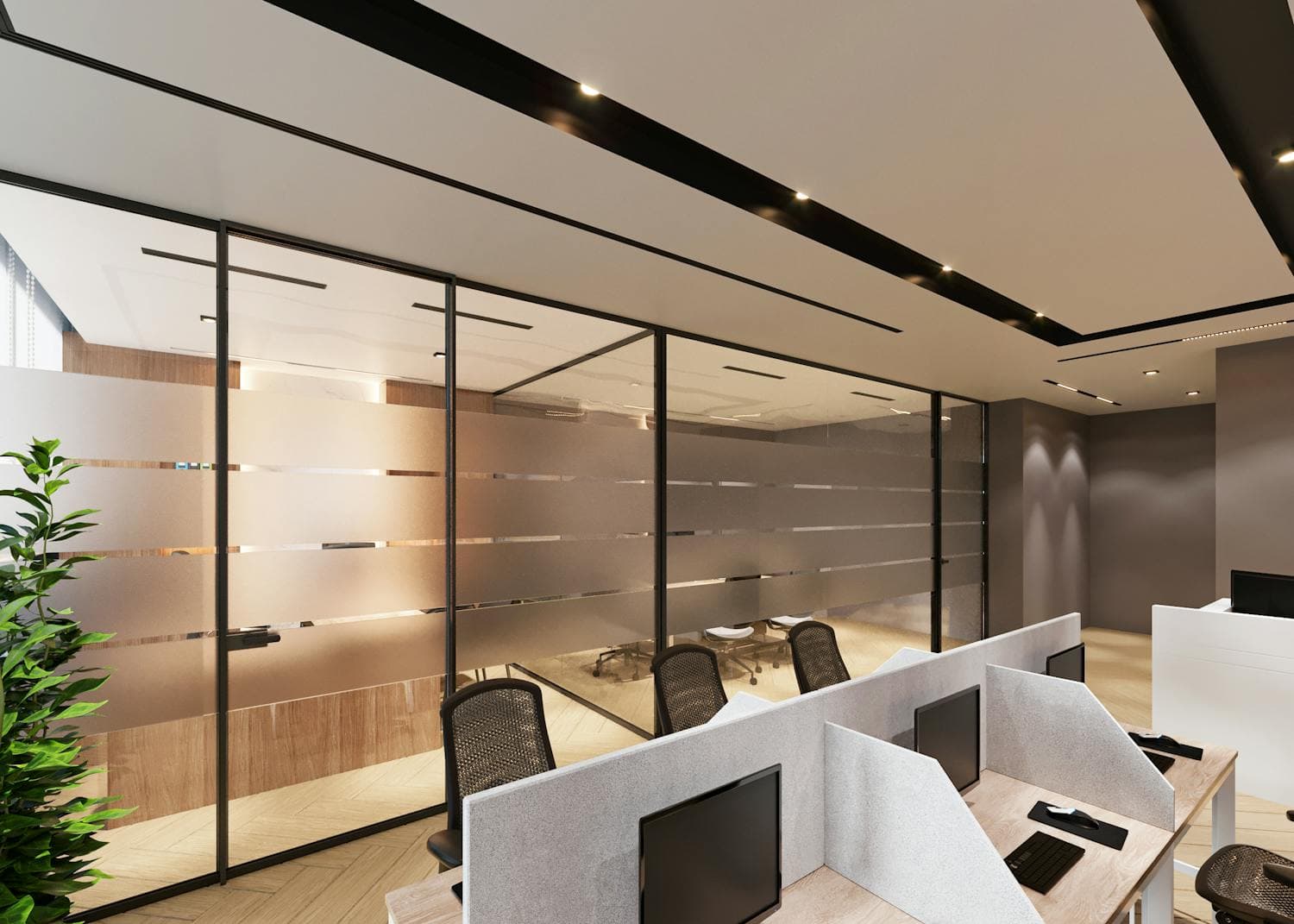
Demountable: Engineered to be taken down and re-erected at a new location or in a new configuration. Demountable office partitions use precision-manufactured components, aluminium framing, and panel systems designed for repeated assembly and disassembly. They look and perform like permanent walls but carry the asset value of relocatable infrastructure.
Modular: Pre-engineered components that assemble into self-contained pods or rooms. Office pods and meeting pods sit at the intersection of modular and demountable. Factory-built, self-contained, and inherently relocatable.
| Feature | Portable | Demountable | Modular |
|---|---|---|---|
| Relocatability | Within same tenancy | Between premises | Between premises |
| Acoustic performance | Low (NRC 0.2–0.4) | Moderate (Rw 35–45) | Moderate–High (STC 30+) |
| Typical use case | Day-to-day flex, visual privacy | Fitout strategy, full floor reshaping | Self-contained pods and rooms |
| Tools required | None | Professional install | Professional install |
| Asset value over time | Negligible | 40–60% retained | 50–70% retained |
For a breakdown of modular partition advantages, see 7 benefits of modular office partitions. Understanding which category fits your situation is the first step toward a scope that actually works.
The Financial Case: When Demountable Partitions Beat Traditional Fitout
Demountable partition systems cost 15 to 25% more per linear metre upfront than standard plasterboard stud walls. If you compare the day-one invoice alone, permanent construction looks cheaper. But day-one cost is not total cost. Three additional line items change the equation:
- Avoided strip-out costs. Make-good obligations at lease end in Sydney can run $20,000 to $80,000. Demountable walls come down cleanly with minimal make-good liability.
- Avoided rebuild costs. Reconfiguring a permanent layout after a restructure typically costs $15,000 to $40,000. Demountable systems reconfigure without demolition, waste, or weeks of disruption.
- Residual asset value. A plasterboard wall has zero residual value the moment it goes up. A demountable system retains 40 to 60% of its original value because it relocates to your next premises.
The chart below models these three cost lines across a typical 80 linear metre Sydney partition scope, showing how the total cost equation reverses over a 5-year lease.
5-Year Total Cost: 80 Linear Metre Sydney Partition Scope
The net gap widens further on leases with more than one reconfiguration, which is why the breakeven threshold extends to seven years even with conservative assumptions.
For leases under five years, the case is clear-cut. For leases up to seven years, demountable systems still typically cost less over the full term. If your business has restructured in the past three years, the reconfiguration savings alone close the gap. For full cost benchmarks, see Stemar Group’s office partition cost guide for Sydney.
Where Flexibility Wins and Where It Does Not
Flexibility wins when: your lease is under five years, your headcount is growing or uncertain, you have restructured in the past three years, or you need to demonstrate sustainability credentials for reporting or tendering. For businesses that fit this profile, Stemar Group’s demountable office partitions deliver measurable value over the lease term.
Flexibility loses when: you hold a long lease on stable headcount, client-facing areas demand premium finishes only permanent construction delivers, or acoustic-critical environments need Rw 50+ ratings that exceed most demountable systems. Often the best outcome is a blended approach: permanent walls where performance matters most, demountable systems everywhere else. Stemar Group coordinates both under a single project manager to ensure seamless integration.
Frequently Asked Questions About Portable Office Partitions
Will installing demountable partitions disrupt our operations?
Minimal disruption compared to traditional stud wall construction. Demountable systems install 30 to 40% faster because there is no wet plastering, no sanding dust, and minimal ceiling work. Stemar Group uses staged delivery and after-hours work to keep your floor operational throughout.
How do portable office partitions compare on cost to traditional stud walls?
Higher upfront, lower over the lease term. For leases under five years, demountable systems typically cost less in total once you factor in avoided strip-out ($20,000 to $80,000), avoided rebuild ($15,000 to $40,000), and residual asset value (40 to 60% retained). Stemar Group provides fixed-price quotes so you can model the comparison before committing.
How do demountable partitions compare to plasterboard stud walls?
Plasterboard costs less upfront but has zero residual value and cannot be relocated. Demountable partitions cost 15 to 25% more at install but can be disassembled, transported, and re-erected at a new location. They reduce make-good liability, avoid demolition waste, and retain 40 to 60% of their value across multiple lease cycles.
Can we take demountable partitions with us when we move premises?
Yes. The panels, framing, and glazing are designed for repeated disassembly and reassembly. Your fitout partner documents the system components, manages disassembly, transports the materials, and re-erects them to suit the new floor plate.
Do demountable partition systems meet acoustic requirements for offices?
For most commercial office environments, yes. Modern demountable wall partitions achieve Rw values of 35 to 45, making them suitable for meeting rooms, private offices, and general workspace separation. They may not suit acoustic-critical environments like call centres where permanent construction delivers Rw 50+.
How do reusable partition systems support ESG reporting?
Your fitout partner should provide a material schedule documenting every panel, frame, and glazing unit by weight and material type. This feeds directly into NABERS, Green Star, and IS Rating frameworks. Auditors look for documented material-reuse percentages, waste-diversion data from the installation, and evidence that the system was specified for reuse rather than retrofitted for it. Stemar Group provides this documentation as part of every demountable partition scope.
Is a flexibility assessment the right next step for your workspace?
Three questions will tell you whether demountable systems are worth exploring:
- What is your remaining lease term?
- Is your headcount stable, growing, or uncertain?
- Do you have ESG or sustainability reporting obligations?
If any of those answers point toward change rather than stability, a conversation is the right next step.
Stemar Group works with mid-market commercial and industrial businesses across Sydney. Based in Wetherill Park, in the heart of the Smithfield-Wetherill Park Industrial Estate, we are local to the businesses we serve. When you call, you speak directly with an owner. Contact Stemar Group to book a flexibility assessment and find out whether demountable partitions are the right call for your workspace, your lease, and your headcount trajectory.