

If your commercial lease is coming to an end, there is a good chance it contains an office make good clause. It is one of the most misunderstood parts of a commercial lease, and one of the most expensive to get wrong. This guide explains what make good means, the main types of clause, what the work actually involves, and how Sydney tenants can keep the cost under control.
What office make good actually means
Make good is a clause that requires you, the tenant, to return the premises to an agreed condition when the lease ends. In plain terms, the landlord wants the space handed back in a state they can re-lease, and the lease sets out exactly what that state is.
The catch is that “agreed condition” varies enormously from one lease to the next. Some leases ask for the original condition at the start of your term. Others ask for a bare base building or shell. Others only ask you to repair damage beyond fair wear and tear. The wording of your specific make good provision is what determines the scope, and therefore the cost.
This is why two businesses of the same size in the same building can face completely different make good bills. It is not about the space. It is about what the clause says.
The main types of make good clause
Most commercial make good clauses fall into one of four categories. Knowing which one you have is the first step to understanding your exposure.
Most commercial make good clauses fall into one of four categories, and the one in your lease is what sets both the scope and the cost. The graphic below breaks down what each type asks you to do.
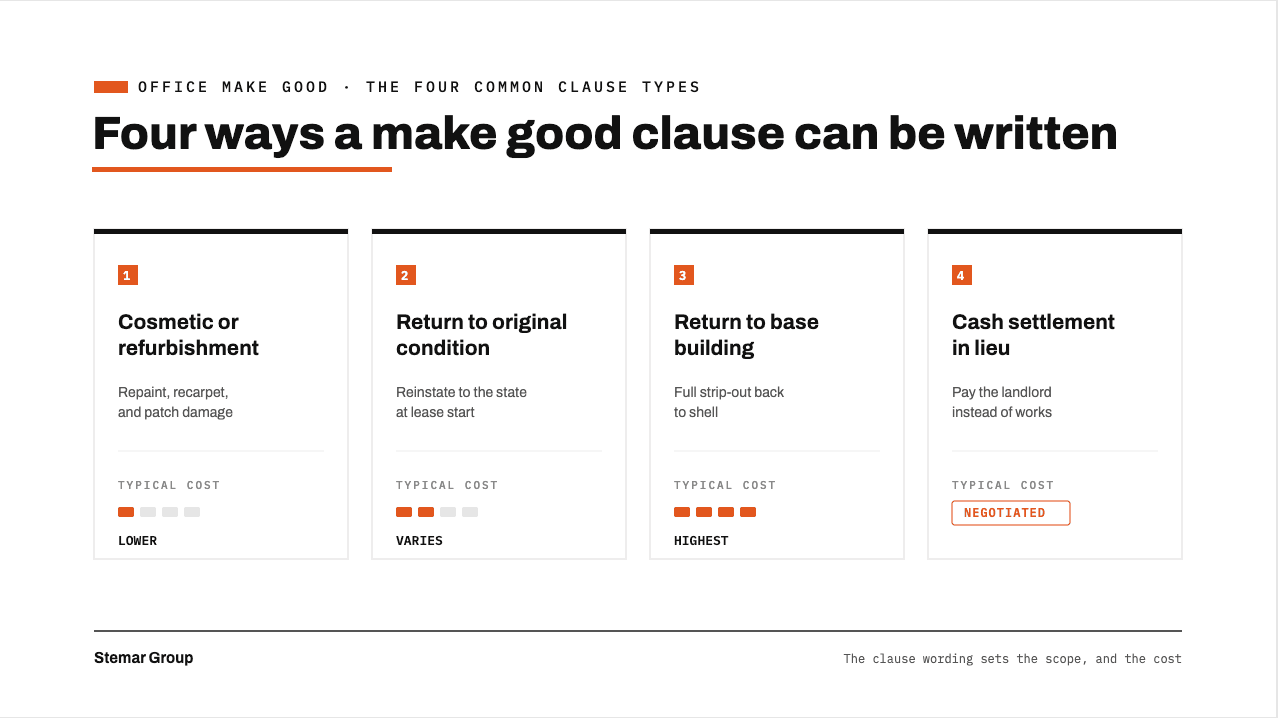
Knowing which of these four your lease contains is the first step to understanding your exposure. If you are not sure, the wording of your make good provision, not the size of your office, is what to check first.
| Type of clause | What it means for you |
|---|---|
| Return to original condition | Reinstate the space to how it was at the start of your lease, using the condition report from commencement as the benchmark. Cost depends on how much you changed. |
| Return to base building or shell | Strip the tenancy back to a bare base building state, removing partitions, finishes, and services fit-out. This is usually the most expensive outcome. |
| Cosmetic or refurbishment clause | Repaint, replace floor coverings, and repair damage, without a full strip-out. Lower cost and more common in shorter or lighter fit-outs. |
| Cash settlement in lieu | Instead of doing the physical work, you pay the landlord an agreed sum. Useful when the landlord plans to refit anyway, but the figure needs to be negotiated carefully. |
What make good work typically involves
Once you know the standard your clause requires, the physical scope becomes clearer. A typical office make good can include some or all of the following:
- Removing partitions, meeting rooms, and any built joinery installed during your fit-out.
- Taking out data and electrical cabling, and reinstating the ceiling grid and tiles.
- Removing signage, branding, and wall graphics, then patching and repainting.
- Reinstating floor coverings and repairing any damage to the base building.
- Removing kitchenettes, plumbing, or supplementary air conditioning added for your use.
- Returning services such as lighting and mechanical to the base building configuration.
The lighter your original fit-out, the shorter this list. A business that only painted and added a few partitions has far less to undo than one that reconfigured a whole floor.
What drives the cost of an office make good
There is no single make good price, because the cost is driven by your specific situation. The main factors are:
- Size of the tenancy: More floor area means more to strip out and reinstate.
- Extent of your alterations: The more you changed during the lease, the more there is to undo.
- The standard your clause requires: Base building strip-out costs more than a cosmetic refresh.
- Building access and hours: Work in an occupied or high-rise building, or restricted to after hours, adds time and cost.
- The condition record from lease start: A clear baseline avoids disputes and scope creep, which is where budgets blow out.
Because these vary so much, the only reliable number is a fixed-price quote based on your actual lease clause and the current state of the premises. Our related guide on office refurbishment costs in Sydney also covers how make good provisions can interact with a refurbishment budget.
Why the condition report at lease start matters so much
The single most useful document in any make good is the schedule of condition, the photographic and written record of the premises taken when you moved in. It sets the baseline that a “return to original condition” clause is measured against.
If that record is thorough, disputes are rare, because both sides can see exactly what the space looked like at the start. If it is missing or vague, the landlord can argue for a higher standard than you actually inherited, and you can end up paying to hand back a better space than you were given. If you are signing a new lease now, commission a proper condition report before you fit out. It is cheap insurance against an expensive argument years later.
How to reduce your make good cost
Make good cost is not fixed in stone. There are practical steps you can take, and the earlier you take them, the more they save.
- Negotiate the clause when you sign the lease: This is where you have the most leverage. Cap the scope, exclude fair wear and tear clearly, or agree a cosmetic standard rather than a full base building strip-out.
- Design your fit-out with make good in mind: Demountable partitions, surface-mounted services, and reversible finishes are far cheaper to remove later than fixed, built-in work. Decisions made at fit-out stage directly shape your make good bill.
- Keep records throughout the lease: Hold on to the condition report, fit-out drawings, and any landlord approvals for alterations. They define what you are and are not responsible for.
- Consider a cash settlement: If the landlord intends to refit for the next tenant anyway, a negotiated payment in lieu can be cheaper and cleaner than doing works that will be torn out.
- Start early: Planning the make good months before expiry gives you time to get competitive quotes rather than paying a premium for rushed work.
When to start planning your make good
Make good has a hard deadline, the end of your lease, and missing it is costly. If the premises are not handed back in the required condition on time, you can be held over and charged additional rent, or the landlord can complete the works and bill you at a rate you had no control over.
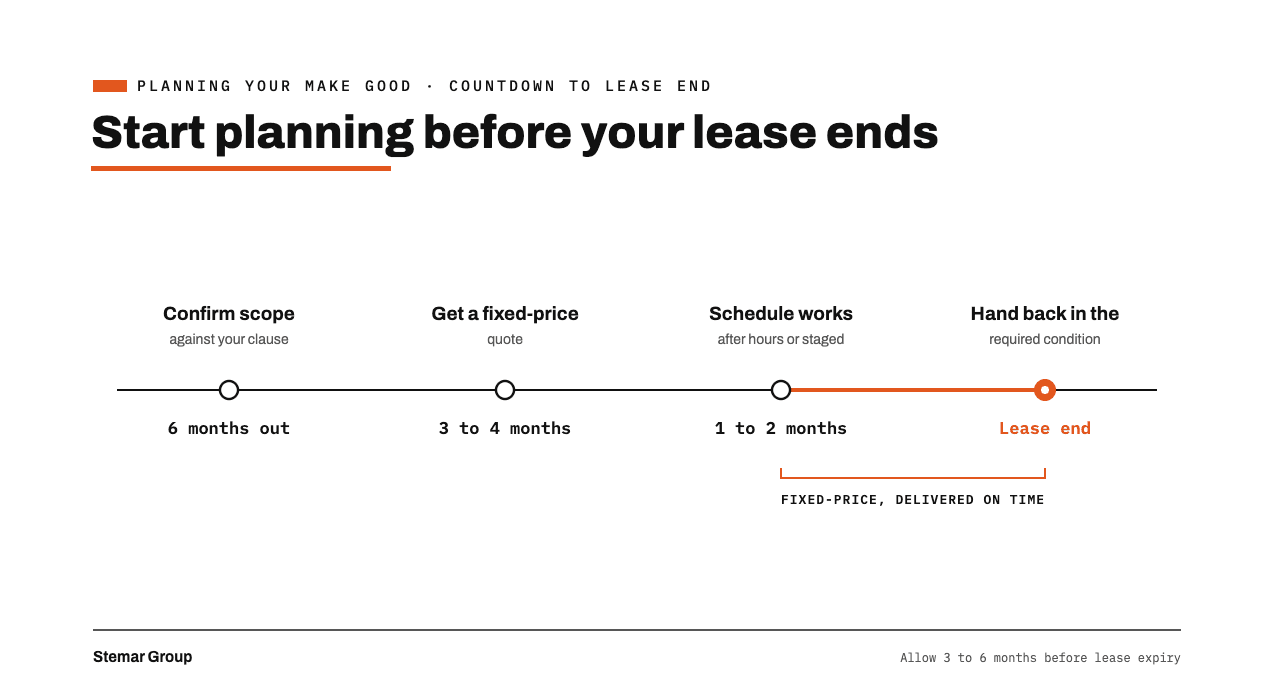
As a rule, start planning at least three to six months before lease expiry. That leaves room to confirm the scope against your clause, get a fixed-price quote, and schedule the works, often after hours or in stages, so the space is ready to hand back on the day the lease ends.
Make good, or stay and refurbish
Not every lease end has to mean a make good. If your business is happy where it is, renewing the lease and refurbishing the space is often cheaper than making good and relocating, once you factor in moving costs and downtime. It is worth weighing both paths before you commit. Our guide on office refurbishment at lease renewal walks through that decision, including how make good obligations affect the numbers either way.
How Stemar Group delivers make good works
Make good is one of the core services we deliver, alongside fitouts, refurbishments, and partitions. Because we build the fit-outs in the first place, we understand exactly what needs to come out and what should stay, which keeps the scope tight and the cost honest. You can see the full range on our services page.
Every make good runs on the same principles as the rest of our work. A fixed-price quote based on your actual lease clause, so there are no surprises at the end. Direct involvement from Steve and Mario rather than layers of account managers. And staged or after-hours delivery where needed, so the space is handed back on time without disrupting your final weeks in the building.
Approaching the end of your lease? Talk to us about a fixed-price make good quote based on your specific clause.
Frequently asked questions about office make good
What does make good mean in a commercial lease?
Make good is a lease clause that requires a tenant to return the premises to an agreed condition at the end of the lease. Depending on the wording, that can mean the original condition at the start of the lease, a base building or shell condition, or simply repairing damage beyond fair wear and tear. The exact obligation depends on how the clause is written.
How much does an office make good cost?
It depends on the size of the tenancy, how much the space was altered during the lease, and the standard the clause requires. Stripping a heavily fitted-out floor back to base building costs far more than patching and repainting a lightly changed space. The most reliable figure is a fixed-price quote based on your specific lease clause and current condition.
Can I negotiate a make good clause?
Yes. Make good is often negotiable, both when you sign the lease and near the end of the term. Common outcomes include capping the scope, agreeing a cash settlement in lieu of physical works, or reducing the standard you must reinstate to. Negotiating at lease signing, before you fit out, usually gives you the most leverage.
What happens if I do not complete make good on time?
If the premises are not returned in the required condition by the end of the lease, you can be held over and liable for additional rent, or the landlord may complete the works and bill you, often at a rate you did not control. Planning the make good well before lease expiry avoids both outcomes.
Do I have to remove everything from the office?
Not always. What must be removed or reinstated depends on the clause and on the condition recorded at the start of the lease. Partitions, cabling, signage, and tenant fixtures are commonly removed, while base building elements usually stay. A clear condition report from lease commencement is the reference point for any dispute.